
UCLA Center for Community Schooling Research Report 1-RR-19
The Power of Self-Assessment
Using Community-Based Measures to Advance Biliteracy
July 2019

Introduction
Student self-assessment is a powerful tool that facilitates student learning and development when practiced in classroom spaces where students feel safe and comfortable (Andrade & Heritage, 2018). Self-assessment in these environments has the potentiality to afford students opportunities to explore how the content learned in school connects to their passions, communities, cultures, and identities as they use their own formative and summative assessment data to course correct. Furthermore, self-assessment provides educators with unique insight into students’ perceptions and beliefs about their educational experience. These insights coupled with other student data, impart a comprehensive picture of students’ progress. However, in order to holistically analyze student self-assessment data alongside other student data, it is imperative that the tools (instruments, assessment measures) used to collect the self-assessment data and the classroom routines used to teach self-assessment skills align with the domains, values, and/or competencies that undergird a school-community’s local assessment system (Quartz, Kawasaki, Sotelo, & Merino, 2014).
This report provides practitioners and researchers with an interactive roadmap that documents how educators and researchers partnered to pilot and design a community-based self-assessment system composed of self-assessment instruments (i.e., tools, assessment measures) and classroom routines (i.e., instructional practices that promote self-assessment skills) across grade-levels (grades 2 – 12). This report highlights how the design process informed instruction and curriculum development. The design process also helped the school refine their local language policies to improve its dual language elementary school program (grades K – 6) and support the multilingual-learning environment in the secondary school program (grades 7 – 12). In addition, this report illustrates how self-assessment instruments and classroom routines, together, provided students opportunities to take ownership of their assessment data, and evaluate their disciplinary-content knowledge (e.g., reading, social studies, science) and passions as multilingual language users. Lastly, the report showcases real-life examples of self-assessment in practice, and how teachers and students used its results for action.
Navigating the Report
The body of this report provides a brief summary of the design, development, pilot, and administration of UCLA-CS’s self-assessment system, which is composed of the Reader Identity Self-Assessment (RISA) Instrument and the Multilingual Interdisciplinary Social Action (MISA) Self-Assessment Instrument. When relevant, brief descriptions of classroom routines that supported and promoted the self-assessment instruments are discussed. To learn more about the material presented in each section, click on the hyperlinks embedded in the text and/or the thumbnails along the right-hand margin.
The Reader Identity Self-Assessment (RISA) Instrument
The elementary school teachers and a researcher partnered to design the Reader Identity Self-Assessment (RISA) instrument because teachers noticed that they were the sole users of students’ longitudinal reading data and they wanted a tool that would facilitate students’ analysis of their own data. Thus, the RISA was designed to provide both teachers and students with formative data to inform reading instruction and learning. While designing the RISA instrument, teacher-researcher teams developed reading lessons to scaffold students before they completed each self-assessment in the RISA series.
The RISA is administered in the fall and spring to students in second- to fifth-grade. In the fall, students look at their reading levels in both languages and graph them overtime, making conclusions about factors that may have impacted their reading growth. Students analyze their Spanish and English data together, set reading goals, prepare a plan, describe the reading practices needed to realize their goals, and reflect on their “bilingual or multilingual reader selves.” In the winter, they monitor their progress, and in the spring, students update their longitudinal bar graphs by adding their spring reading levels in both languages. Then, students reflect on their progress by describing why they met (or did not meet) their reading goals and how they managed obstacles. Lastly, students once again reflect on their “bilingual or multilingual reader selves.” Refer to the List of Self-Assessment Routines for more information about the scope and sequence of the RISA.
Teachers and researchers are currently revising the sixth grade RISA, so information and data about the sixth grade RISA was excluded from this report.
To view the questions and prompts from the RISA, click here for the lower elementary grades (2nd– 3rd gr.) and click here for the upper elementary grades (4th – 5th gr.).
The Multilingual Interdisciplinary Social Action (MISA) Self-Assessment Instrument
In the secondary school, social studies teachers, science teachers and researchers partnered to create curriculum and assessments for Multilingual Interdisciplinary Social Action (MISA) Projects. The MISA Projects are products of the current social, political, and economic factors facing the school community. UCLA-CS believes these projects will afford students with tools to support their community and beyond. The MISA Projects highlighted in this report attempt to set a framework for social action projects across disciplines. This inquiry has led the way in developing the school’s understanding of the intersection between multiculturalism, bilingualism, and social justice.
Key components of the MISA Projects include interdisciplinary curriculum, a self-assessment instrument, project-based assessments, and a progression. The MISA progression attempts to capture UCLA-CS’s vision for what a graduating, multilingual student, who is an active and critical participant in our society, should be able to do by the time they leave the school. The progression was created to support curriculum and self-assessment development. The MISA Self-Assessment instrument measures how students’ sense of identity, language, and relationship to social issues and action changes over time for a given project. Teachers use the student self-assessment data to modify their curriculum and instruction in order to support student growth in these areas. The MISA Self-Assessment instrument is administered in the fall and spring, after students complete a MISA Project.
In What Ways Are Self-Assessment Instruments Community-Based?
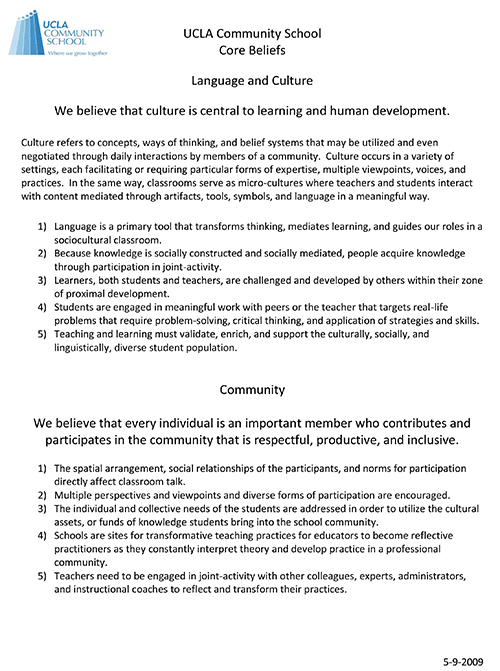
A community-based self-assessment is an assessment that is designed by teachers, parents, and/or school partners (e.g., researchers) using constructs that stem from a school-community’s core values. For example, at UCLA-CS, it is essential for the school’s vision as a community school to frame their assessment to theirschool-community values. UCLA-CS’s core beliefs state that:
- teaching and learning must complement the culturally, socially, and linguistically, diverse student population;
- each person is an important member who contributes and participates in the community respectfully, productively, and inclusively;
- students should be encouraged to think critically of the world around them; and
- students and parents are agents of social change.
The school’s values are expressed through anti-racist and culturally relevant teaching. Culturally relevant teaching and pedagogy require that educators create opportunities for students to critically examine social, economic, and political conditions, as well as view themselves as social agents that are capable of shifting these conditions (Gay, 2010; May, 1999; Ladson-Billings, 1995; Nieto, 2009; Paris, 2012). At UCLA-CS, students are taught to consider their identities, languages, histories, and cultures as assets — powerful tools for social transformation. In addition, UCLA-CS attempts to help students contemplate the potentiality of skills such as collaboration, critical thinking, self-expression, and learning for action.
School-community values
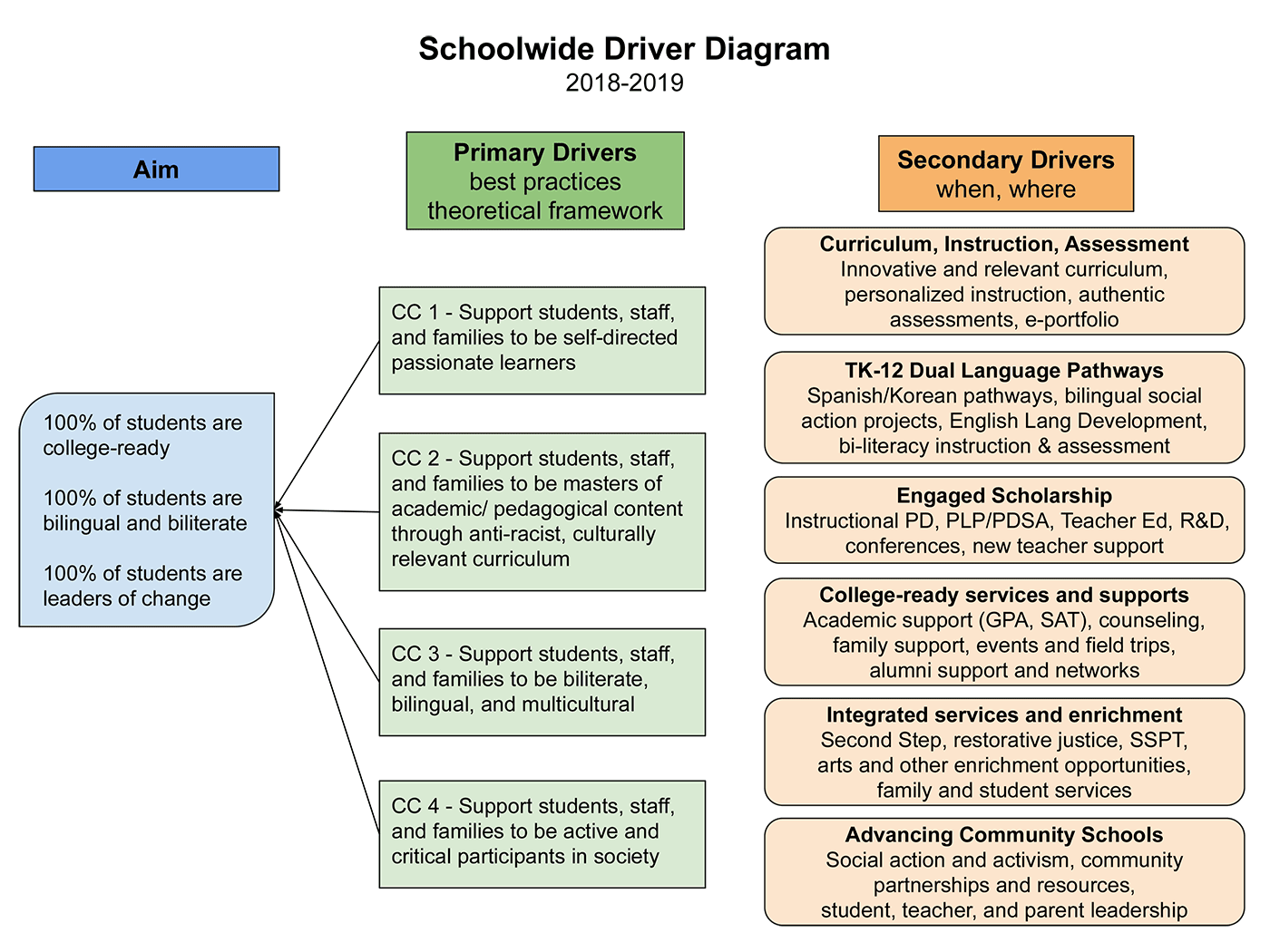
The school’s values are also characterized by the school’s four core competencies (4CCs)— self-directed and passionate learner (CC1), mastery of content knowledge and skills (CC2), biliterate, bilingual, and multicultural (CC3), active and critical participant in our society (CC4). UCLA-CS uses the four core competencies as primary drivers to directly achieve school-level aims, which inform (a) curriculum, instruction, and assessment; (b) TK – 12 dual language pathways; (c) engaged scholarship; (d) college-ready services and supports; (e) integrated services and enrichment; and (f) advancing community schools. During the 2010-11 school year, a team composed of UCLA-CS teachers and researchers interviewed UCLA-CS teachers to document the school’s collective understanding of what each 4CC meant to teachers. The study team — Quartz, Kawasaki, Sotelo, and Merino (2014) — found that “teachers’ articulation of the 4CCs closely aligned with research-based conceptions of the same ideas” and that “making explicit teachers’ tacit knowledge about these competencies helped…build a strong foundation for developing assessments that are both useful and valid” (p. 134). They concluded:
Teachers have a unique knowledge base about their craft, yet rarely are they supported to articulate a common set of [student] competencies in sufficient depth to undergird a robust local assessment system. Encouraging teachers to give thoughtful consideration to the skills and behaviors that reflect a comprehensive picture of the specific [student] competency they wish to assess is an important initial step before either choosing or developing assessments to measure student competency (p. 147).
From this epistemological perspective, a community-based self-assessment system has self-assessment instruments, classroom routines, and curriculum that are designed by members of the school community and school partners using carefully studied constructs that concurrently align to: (1) the student, teacher, or parent community the school serves and (2) the developmental, psychological, and educational literature germane to the school community.
What Do Self-Assessment Instruments Tell Us About Students?
Self-assessment, at UCLA-CS, is the act of documenting, monitoring, and evaluating progress, providing or receiving feedback, as well as adjusting individualized and classroom learning plans to meet learning goals (Andrade & Heritage, 2018). Similar to common formative assessments, our self-assessment instruments were collaboratively designed by teacher teams, who also collectively analyzed the student data from the assessments (Ainsworth, 2007). Although common formative assessment and self-assessment are typically designed to gauge student understanding of the learning standards (Panadero, Brown, & Strijbos, 2016), UCLA-CS’s self-assessment instruments were designed to also gather insight on how students are developing the social and psychological skills necessary for academic achievement (as illustrated by CC1, CC3, and CC4). The school’s self-assessment instruments are administered after a project (i.e., Interdisciplinary Multilingual Social Action Project) or benchmark assessment (i.e., Spanish and English reading proficiency assessment). Students use their own formative or summative assessment data to monitor their learning, evaluate their progress, and course correct.
Self-assessment, is typically composed of self-regulatory (or self-directing) elements, such as monitoring, evaluation, and feedback (Bailey & Heritage, 2018; Harris & Brown, 2018). These elements have been found to be predictive of academic achievement (Brown & Harris, 2013; Duckworth, Tsukayama, & May, 2010; Zimmerman, 1990), language development (Bohlmann, Maier, & Palacios, 2015) and long-term educational outcomes (McClelland et al., 2013). For this report, we refer to Hadwin, Järavelä, and Miller’s (2018) definitions of self-regulation, socially-shared regulation, and co-regulation. Self-regulated learning refers to the process by which learners take control of cognitive, behavioral, motivational, and emotional conditions or states through a series of iterative actions, including planning, monitoring, evaluating, and revising. Socially-shared regulation refers to groups collaboratively and collectively taking metacognitive control of a task by making iterative adjustments to cognitive, behavioral, motivational, and emotional conditions or states–as needed. Co-regulation refers to a transitional and dynamic metacognitive process through which learners’ self-regulation and shared regulation of cognition, behavior, motivation, and emotions are supported (or hindered) by interpersonal interactions and exchanges. During co-regulation, learners, with support, are acquiring the necessary skills to partake in self-regulation (individual) or shared-regulation (group).
Overall, regulated learning (self-, co-, and shared) is a cyclical metacognitive and social process that involves adjusting one’s thoughts, motivations, emotions, and behaviors (Hadwin, Järavelä, & Miller, 2018). Regulation is socially situated. There is a reciprocal relationship between regulation, socio-contextual conditions (people, context, cultures; Winne & Hadwin, 2008), and language competence and language learning (Bailey & Heritage, 2018; Cerda, Bailey, & Heritage, under review; Mottier Lopez & Allal, 2007). For instance, if the socio-contextual conditions of a classroom provide students with a sense of security, then, when self-assessing, students are more likely to realistically and honestly self-reflect and self-express their values and ideas (Andrade & Heritage, 2018). A safe space to self-assess would also engender a sense of purpose as students comfortably explore their social and academic identities (Batra, 2013; Sergiovanni, 2001). Refer to the following AERA paper for classroom examples that highlight the relationship between regulation, classroom environment, and language learning.
Considering that students enrolled at UCLA-CS are linguistically and culturally diverse, it was important for teachers to include a multilingual component where students reflected on their language-learning experiences in Spanish, English, and any additional languages they used at home. For instance, students in the secondary school (grades 7 – 12), who completed the MISA Self-Assessment, identified the languages they used to complete project elements (relating to reading, writing, listening, speaking), and described why they were successful at communicating with different community members. Then, they explained what they would do differently next time and what they learned about themselves as users of one or more languages. Students in the elementary school, who completed the RISA (grades 3 – 5), identified whether they were monolingual, bilingual, or multilingual readers, shared which languages they used to read, explained why they read using one or more languages, reflected on how they felt about reading different languages, and described what they learned about themselves as readers of those languages.
Moreover, teachers were cognizant of the reciprocity between language, culture, and identity (Gee, 2015), as well as the influence students’ academic, ethnic, and cultural identity (self-concept) has on academic achievement and motivation (Fuligni, Witkow, & Garcia, 2005; Marsh & Martin, 2011; Oyserman & Destin, 2010). Thus, drawing from the field of language motivation (Dörnyei & Ryan, 2015) and social psychology (Higgins, 1987), we designed the RISA and MISA self-assessment to include identity questions that prompted students to reflect on the self as it related to the content and languages they were learning in the classroom. For instance, students in the secondary school first reflected on the various identities or roles they enacted during a social action project. Then, they described why they saw themselves in that way and explained how this knowledge about themselves would inform who they would like to become. In the elementary school, students, who completed the RISA (grades 3 – 5), reflected on the bilingual and multilingual readers they would like to become by describing the kind of bilingual and multilingual reader students hoped to be (i.e., the ideal reader self).
Theoretical Perspectives
What theories of human development informed the expansion of the self-assessment system at UCLA-CS from second grade to twelfth grade?
As UCLA-CS expanded their self-assessment system across grade levels, teachers were interested in understanding how regulated learning, identity, as well as social and cultural exchanges developed at different grade-levels (and ages). For instance, teachers wanted to know how a second-grade student’s regulatory-learning behavior and identity development might differ from a fifth-grade student, middle school student, and high school student. Understanding developmental characteristics across grade levels would allow the participating teachers and researchers to test whether their expectations were developmentally relevant as they were designing the RISA and adapting it for the secondary school (i.e., the MISA Self-Assessment). Thus, teachers and researchers drew from Erikson’s (1994) framework of psychosocial development, the life cycle completed, which is composed of eight stages of human development (see Table 2).
Erikson connects these eight stages to growth of maturity (self-regulation) and the influence of social and cultural exchanges (e.g., play, reading, writing, communication) (Bantra, 2013). Together, these components help one understand how an individual develops a sense of self (see Table 3). According to Erikson (1994), components, such as social relationships (e.g., parent, peers, teacher) and cultural experiences (e.g., reading, communication) that influence human development are significant in shaping one’s sense of self across the different stages. These components influence how a person reconciles opposing emotional forces or psychosocial crises at each stage to develop either basic strengths (or antipathies) that either support (or hinder) development at the next stage. The life cycle stages, although sequential, do overlap as different components from one stage unfold and build on the next over time. How adaptive an individual is at each stage is dependent on basic strengths, social experiences, and self-regulation skills acquired from the previous stage.
Teacher-Researcher partners focused on the developmental stages pertinent to the students who would be taking the RISA and MISA: School Age (Stage IV) and Adolescence (Stage V).
School Age (Stage IV):
When a student reaches school age, they are reconciling feelings of industry and inferiority (psychosocial crisis).The student tries to find resolve between feelings of pride and feelings of inadequacy with their school work, social activities, and family life. As a student works toward a resolution, feelings of competence (strengths) are increased while feelings of inertia (antipathies) decrease. Thus, when designing the RISA for school age students it was important to ensure that the instruments helped students view obstacles as essential to improvement while also highlighting growth and celebrating the moments when they felt most successful in order to enhance a sense of industry and competence.
Adolescence (Stage V):
When a student reaches adolescence, they are exploring identity and identity confusion (psychosocial crisis). The latter being a normative and necessary experience that can become maladaptive. Although, notions of identity are explored during childhood, these previous experiences are reviewed for selection and commitment by the student during adolescence. Students find resolve by remaining true to their beliefs and values regardless of the obstacles they may encounter. As they work towards a resolution, they develop more feelings of fidelity (strengths) than repudiation (antipathies). Thus, when designing the MISA Self-Assessment for adolescent students, teachers and researchers included questions that asked students to reflect on the various roles (identities) they enacted while working on the MISA Project and discuss how the ideas they had gathered about themselves related to some of their academic endeavors in order to support identity formation.
The School Site
The UCLA-Community School (UCLA-CS) is a community-based, learner-centered, university-partnered public-school serving grades TK – 12. It is located in one of the state’s most densely populated immigrant neighborhoods in Los Angeles, and as such, the school enrolls more transient and immigrant students than the district as a whole. The school enrolls approximately 1, 003 students (49.3%, n = 494 female students). Most students enrolled are Latinx (81.4%, n = 816), English Learners (31.7%, n = 318), and/or socioeconomically disadvantaged (88%, n = 883). Some students are reclassified fluent English proficient (52.6%, n = 528), have special needs (14%, n = 140) and are gifted and talented (14.3%, n = 143). In 2016-17, most of the faculty was Latinx (44%), Korean (19%), and Caucasian (15%). Most of the faculty is bilingual (88%) and trilingual (8%), and many have a master’s degree (71%).
The elementary school (grades TK – 6), also known as the Lower School, offers two language pathways. Students enroll in either the Korean world language pathway or the Spanish dual language immersion (DLI) pathway. All students in the elementary school are grouped in multi-age dens—Den 1 (grades K – 1), Den 2 (grades 2 – 3), and Den 3 (grades 4 – 5). Students remain with a teacher for two years before moving on to the next Den. This report focuses on data collected from students enrolled in the Spanish DLI pathway, although all students enrolled in the Lower School partook in the self-assessment instruments and routines discussed here.
The Spanish DLI program provides Spanish and English literacy and content instruction to students in order to promote bilingualism and biliteracy, grade-level academic achievement, and sociocultural competence (see Howard et al., 2018 for an example of DLI program models). The Spanish DLI program follows a 90:10 approach to language instruction allocation, in which the partner language (e.g., Spanish) is used for instruction 80%-90% of the time (and English 10%-20% of the time) during Den 1. Throughout Den 2, Spanish is used for instruction 60%-70% of the time, and by the end of Den 3, the ratio of Spanish-English instruction reaches 50:50. While teachers in the Spanish DLI program allocate instruction in English and Spanish, how much exposure students have to Spanish instruction varies across classrooms and Dens. Teachers also employ fluid language practices, using both languages interchangeably.
The secondary school (grades 7 – 12), also known as the Upper School, is composed of content-specific Divisions—Science, Mathematics, English, Social Studies, and World Languages (Spanish courses). As of next year, the secondary school will provide a dual language pathway, grades 7 – 12.
Schoolwide Driver Diagram
Collective Understanding of the 4CCs
| 4CCs | Teacher Definitions (circa 2011 – 2012 school year) |
| Self-directed and passionate learner (CC1) | Teachers defined a self-directed and passionate learner as passionate (i.e., “seeks knowledge out”), self-regulated (i.e., “being organized and taking responsibility”), and a self-advocate (i.e., “seeks feedback and listens to others”). Teachers struggled with identifying how self-directed learning would be evaluated. |
| Mastery of content knowledge and skills (CC2) | Teachers expected students to master a knowledge base (i.e., “mastering reading and writing”), develop communication (i.e., “be able to clearly communicate their ideas”) and analytic skills (i.e., “develop an argument”), as well as develop an intellectual capacity (i.e., “clearly analyze and explain their ideas” and “be open to learning new things”). Teachers expressed the need to establish common grading practices and assessments that would allow the school to articulate how it measured students’ mastery of academic content and skills. |
| Bi-literate, bilingual, and multicultural (CC3) | Teachers from the Lower School perceived this competency differently than teachers from the Upper School. Teachers from the Lower School recognized this competency to be related to multiple language fluency (i.e., “able to read, write, speak, and listen” and “use appropriate complex vocabulary in both languages”). All teachers defined this competency as multicultural—ideas about cultural awareness (i.e., “recognize and value other cultures”) and cultural immersion (i.e., “being able to connect and empathize with other people and communities”). Teachers found that although assessing language competency is straightforward, it was difficult to assess a student’s understanding of multiculturalism, in that it seemed to be embedded within all of the core competencies. |
| Active and critical participant in our society (CC4) | Teacher reports for this competency were the most varied. Teacher descriptions ranged from personal responsibility (i.e., “law-abiding” and “having a desire to share with others”) to participatory action (i.e., “be socially aware about their community”). Teachers described the critical component of this competency as social activism (i.e., “take the initiative to make changes to society”). They discussed a range of projects they were developing that support students as active and critical participants, but the team did not converse about how to assess these artifacts. |
| Adapted from Hunter Quartz, Kawasaki, Sotelo, & Merino (2014) | |
Piloting and Designing Community-Based Self-Assessment Instruments
The Pilot Process
Various teacher-researcher partnerships designed and piloted the Reader Identity Self-Assessment (RISA) and the Multilingual Interdisciplinary Social Action (MISA) Self-Assessment Instruments.
First, a teacher-researcher partnership composed of a Den 3 teacher and a researcher (first author) conceptualized and designed the RISA for the fourth- and fifth-grade. After the first pilot, they shared the RISA instrument with the Den 3 teacher team, expanding the teacher-researcher partnership to six members.
When the school expanded the RISA instrument to the second- and third-grade, a second teacher-researcher partnership composed of a senior Den 2 teacher (second author) and a researcher (first author) modified the RISA. After piloting, they shared the RISA instrument with the Den 2 teacher team, expanding the teacher-researcher partnership to six members.
After designing, piloting, and revising the RISA instruments, a third teacher-researcher partnership was formulated to adapt the RISA instrument to the secondary school (grades 7 – 12). This teacher-researcher partnership, composed of six teachers from the Social Studies Division (including the third author) and a researcher (first author), designed and piloted the MISA. After the pilot, they shared the MISA instrument with six Science Division teachers, expanding the third teacher-partnership to 14 members. For more information about the pilot process, see Table 4.
The Design Cycle
The design cycle consisted of five steps. To read more about how the RISA and MISA design cycles unfolded click on the steps below. Each step includes detailed descriptions of the RISA and the MISA Self-Assessment instruments. Steps 4 and Step 5 highlight illustrative cases of fourth- and fifth-grade students’ responses to the different RISA questions. These cases informed the design cycles for the second- and third-grade RISA and MISA self-assessment (for grades 7 – 12). Illustrative cases are a small number of cases that describe characteristics specific to the phenomenon under study (Yin, 2003).
Step 1: Identify the purpose and relevant theoretical frameworks
Step 2: Create response questions that align to the purpose and theoretical frameworks
Step 3: Plan the infrastructure, create or modify instruction, and pilot
Step 4: Analyze the data from the pilot and reflect on instruction
Step 5: Revise the self-assessment and modify instruction
Steps 2 – 5 were repeated until the self-assessment measures for each Den or Division aligned with the school’s purpose and relevant theoretical frameworks. During a design cycle, it was also important to consider and determine how teachers and school leaders would sustain this self-assessment practice over time.
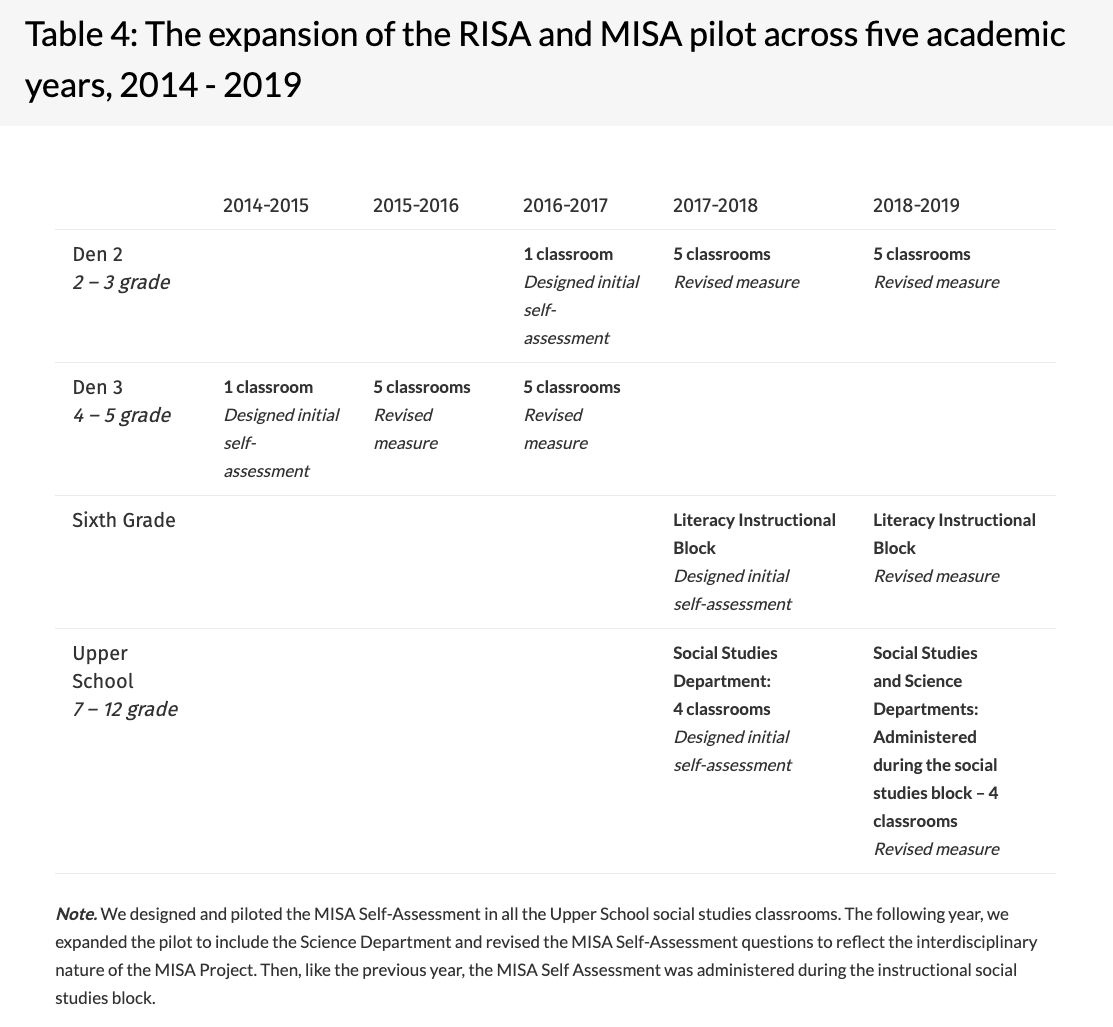
Table 4: The expansion of the RISA and MISA pilot across five academic years, 2014 - 2019
2014-2015 |
2015-2016 |
2016-2017 |
2017-2018 |
2018-2019 |
|
Den 2
|
1 classroom Designed initial self-assessment | 5 classrooms Revised measure |
5 classrooms Revised measure |
||
Den 3
|
1 classroom Designed initial self-assessment | 5 classrooms Revised measure |
5 classrooms Revised measure |
||
Sixth Grade |
Literacy Instructional Block Designed initial self-assessment |
Literacy Instructional Block Revised measure |
|||
Upper School
|
Social Studies Department: 4 classrooms Designed initial self-assessment |
Social Studies and Science Departments: Administered during the social studies block – 4 classrooms Revised measure |
Note. We designed and piloted the MISA Self-Assessment in all the Upper School social studies classrooms. The following year, we expanded the pilot to include the Science Department and revised the MISA Self-Assessment questions to reflect the interdisciplinary nature of the MISA Project. Then, like the previous year, the MISA Self Assessment was administered during the instructional social studies block.
Step 1: Identify the Purpose and Relevant Theoretical Frameworks
The teacher-researcher partnership began by creating an essential question to anchor their inquiry: What are the RISA and MISA Self-Assessment measures meant to elicit from students? Then, they created a purpose statement for the self-assessment measures using the four core competencies. The purpose statement summarized what the self-assessment was intended to measure. For instance, in the elementary school, the RISA instrument was created to help students become multilingual readers (CC#3) that are self-directed and passionate about reading in at least two languages (CC#1). In the secondary school, the MISA Self-Assessment instrument was created to help students meet core competency 1 and core competency 3, as well as become active and critical participants in society (CC#4). Students’ responses from the RISA Self-Assessment instrument was designed to capture how students self-direct (regulate) their disciplinary-content learning and passions as multilingual language users. The MISA Self-Assessment instrument builds on the RISA; It was designed to capture data that shows how students self-direct (regulate) their linguistic repertoires and disciplinary-content learning as passionate, active, and critical participants in their community.
Once the teacher-researcher partnership established the purpose for the school’s K-12 self-assessment system, they researched theoretical frameworks that would help guide them as they designed the self-assessment instruments across the different grade levels. See Table 2. These frameworks informed the teacher-researcher partnership how self-regulatory processes and developmental characteristics (Bembenutty, White, & DiBenedetto, 2016) including psychosocial development looked like at different grade levels (Batra, 2013; Erikson, 1994).
Step 2: Create Response Questions that Align to the Purpose and Theoretical Frameworks
Using the purpose statement and theoretical frameworks, the teacher-researcher partnership began drafting short-response questions for Den 3’s fall and spring RISA instrument, as well as the RISA follow-up in the winter. Then, they followed the same piloting and design process in Den 2 and in the secondary school classrooms (i.e., social studies and science).
For example, the questions about monitoring learning and managing obstacles found in the MISA Self-Assessment were designed to be identical to the questions found in the Den 3 RISA, so teachers could analyze students’ responses longitudinally without concern about whether the questions themselves were influencing students’ responses. If the questions were different, but were created to elicit the same responses, the teacher-researcher partnership would have had to provide further evidence demonstrating that the elicited responses were in fact about the same topic (via coding analysis). Teachers wanted to monitor how students were developing self-regulation processes across grades, especially since self-regulation strategies are essential to mastering academic tasks.
The developmental literature indicates that by the 7th – 8th grade, students are increasing their ability to plan for future actions (e.g., goals) using self-motivational strategies and a range of learning strategies. By the 9th – 12th grade, students are regulating learning independently. They are learning to sustain the ability to independently engage in self-evaluation, and as a result, manage learning strategies, control their social environments, and delay gratification to accomplish a task or a goal. Therefore, by intentionally including nearly identical questions about monitoring learning and managing obstacles across grades (4 – 12 grades), teachers could track how students are developing regulation skills over time so that the necessary scaffolds and interventions could be provided.
Step 3: Plan the Infrastructure, Create or Modify Instruction, and Pilot
Teachers created lesson plans for each self-assessment measure in order to introduce the concepts students encountered in each measure. As a Den, teachers revised the lesson sequence of the reading units (taught in the fall, winter, and spring quarters) by identifying places where the self-assessment lessons fit best. They also incorporated self- and co-regulation practices to prepare students for the RISA self-assessment. Some teachers cultivated these regulation practices across the content-areas to further support student reflection and prepare them for self-assessment. In addition, teachers aligned the administration of the fall and spring self-assessment to the weeks after the independent reading level (IRL) assessments were administered, so that students could reference their (IRL) data when setting goals and plans. Teachers in Den 2 followed a similar curricular pacing. The secondary school’s MISA Self-Assessment is administered twice, in the fall and in the spring after students complete a MISA Project. Following the elementary school’s lead, the secondary school teachers created lesson plans that introduced the concepts students encountered in the MISA Self-Assessment and embedded the lessons in the MISA project curricular unit calendar.
Step 4: Analyze the Data from the Pilot, and Reflect on Instruction
The teacher-researcher partnership used the literature to examine the developmental readiness of the MISA and RISA instruments and revised the questions and prompts that did not align with the developmental research and/or purpose statements.
For example, during the first and second iteration of the Den 3 RISA, some of the short-response questions asked students to compare data from their Spanish and English reading bar graphs: “How is your Spanish reading growth different to your English reading growth?” “How is your Spanish reading growth similar to your English reading growth?” and “ What did you learn about yourself as a reader of Spanish and English?” Teacher-researcher partners analyzed students’ responses as illustrative cases and found that although some students were describing their growth in a positive way, many students were equating the amount of growth in one language to be indicative of being better with reading (and/or using) one language over another language. Students’ wrote:
It’s different because in Spanish I got stuck on Q two times and on English I went growing and growing in my reading level. Another difference is I started from kindergarten in fall learning Spanish and then it keeps on growing. And in English I started learning English since spring first grade and it keeps on going. It’s similar because since the reading level I go to is always growing I would say that a similarity is that I keep growing in my reading level English and Spanish. Another similarity is that both my reading levels go higher than K. I learned by this process that if I work and practice reading it will help me as a reader and it will help with spelling and reading.
My reading level in English is lower than my Spanish reading growth. My Spanish reading growth use to be lower than my English but then it got higher than my English. I have some ups and some downs.
My reading growth in English is different than my Spanish growth because I’m in level X in English and in level R in Spanish. I want my reading levels to be equivalent although I know that some people prefer one language more than the other or some are just better at English than Spanish or the other way around. Although I really want to improve in Spanish I just don’t know how.
Well first of all, English was the first language that I knew so I am better with English for everything. Spanish and English is the same. Sometimes I pass sometimes I fail. I learned to never give up. If you do not pass you train to get better.
It’s different because I’m doing okay but not as good as English and sometimes I don’t understand some words in Spanish. I learned that keep trying and you will get better and better.
I read a higher level at Spanish and at English I read lower. I read both languages and I read 60 minutes. I learned that I am better at Spanish than reading in English.
Sometimes students’ value judgments were supported by the instructor, as noted by the following student reflection: “I learned to embrace that in English I’m better than in Spanish. Besides like my teacher once told me ‘some people are better in English than in Spanish or better in Spanish than in English.’ ” Considering that most students at this grade-level are either developing a sense of industry or inferiority about themselves in relation to their school work and social activity (which includes the languages they speak), the teacher-researcher partners thought it apropos to revise those questions, so that they elicited students to analyze their languages together rather than in isolation.
Step 5: Revise the self-assessment and modify instruction
Some of the revised questions included prompts: “To me, this means…” “I want to be the kind of reader who…” and “How do you feel about reading in two languages? Why?” After piloting the newly revised questions and prompts, teacher-researcher partners analyzed students’ responses once again and found that students were no longer placing value on any one language, and if they did contrast their languages they were doing so using a bilingual/multilingual frame of mind. Students’ wrote:
[To me this means] that I can be a reader and it means to me that I have been growing as I was reading and learning. Also this means that I have been becoming a reader ever since I was in kindergarden. I want to be the kind of bilingual who teaches kids how to become a bilingual reader so they can be a reader. I also want to be a the kind of bilingual reader who helps people who don’t know how to speak Spanish or English. I always feel like a bilingual reader.
[To me this means] that I should read more in Spanish. [I want to be the kind of reader who] can read in all four languages (English, Spanish, Bengali, and Italian) and be able to speak, write, and talk fluently. Proud and happy because I can understand more people now.
To me this means that I need to get to more high reading levels. The last thing it means to me is that I need to start reading way more than before. I want to be someone who can read different types of books. I also want to be someone that really likes to read a lot. I also want to be someone that can read for a long time. I feel proud of myself reading in two languages. I also feel that I can start to read in another language. I feel confident that I can get to [a] higher level in two languages.
This means that I should be proud of myself for all that hard work. Also this is important because it keeps my record over the years. I feel so happy for being in the 5th grade. [I want to be the kind of reader who] helps other people talk different languages because I know some people that can’t speak English and I help them. I want to be an author that makes books. Also, I want to learn different languages. I feel happy.
[To me this means] a lot [and] that my reading is growing. It helps me know that my reading is advancing for college. [I want to be the kind of reader who] can grow up to be what they want to be. That can reach her goals. That can learn from a book and uses what she knows about the book and makes the world a better place. I feel good because it makes me a better reader. It makes me think about how important school is.
[To me this means] that I am trying with all the power of language to become bilingual. [I want to be the kind of reader who] can put as much feeling and understanding in my Spanish reading just as well as my English reading. [I feel] AMAZING! I am super happy I get to read in TWO languages!!
After revisions were applied to the RISA questions, students were less likely to place value on one language over the other, as is evinced by the aforementioned excerpts. Additionally, students’ responses demonstrated that students were interested in understanding how they learned to read languages over time, desired to use literacy to help others, and attributed literacy to learning and college. Furthermore, the revised questions and sentence starters prompted students to analyze their progress (growth) using a bi/multilingual frame of mind rather than isolating their languages. These revisions fostered students self-efficacy about being bilingual or multilingual readers more so than the original questions which may have reinforced negative ideas about their bilingual and biliterate competencies.
This analysis prompted the revision of a Den 2 RISA question. Teacher-researcher partners changed “Compare your Spanish and English reading. How are they similar? How are they different?” to “Look at your bar graphs. What do you notice?” They also modified instruction so that by the end of the bar graph activity, students would understand that they were taught how to read in Spanish first, (K – 1 grade Spring) then English, and, that they used (transferred) their knowledge about reading in Spanish when learning how to read in English. This process also informed the design cycle for the MISA Self-Assessment instrument.
What Did Teacher-Researcher Partners Learn From This Process?
Analyzing students’ responses (in Step 4 and Step 5) helped teacher-researcher partners evaluate the program and prompted them to ask the following questions when designing the self-assessment instruments:
- Which languages are we privileging? How?
- Are we teaching and modeling preference of one language over the other? How?
- How could we teach students to view their languages as part of a linguistic repertoire?
- In what ways are we fostering self-assessment skills across the content-areas?
- How are we teaching the concepts found in the self-assessment measures? Is this instruction vertically and horizontally articulated? Should it be?
- In what ways are we creating a classroom environment where students feel safe sharing their thoughts with others and in writing? Can we do more?
Upper School (Seventh to Twelfth Grade) Questions/Prompts
KEY:
| CC#1 | CC#3 | CC#4 | Identity |
| Before beginning this project, what did you think about the social issue you investigated? Antes de comenzar este proyecto, ¿qué pensabas acerca del problema social que investigaste? |
| What do you think now? Why? ¿Que piensas ahora? ¿Por qué? |
| What went well? Why? ¿Qué te fue bien? |
| What didn’t go well? Why? ¿Qué no te fue bien? ¿Por qué? |
| In what ways would you manage tasks differently next time? ¿De qué maneras diferentes manejarías las tareas del proyecto la próxima vez? |
| Which languages did you use while investigating a social issue? ¿Cuáles idiomas usaste a lo largo del desarrollo de tu proyecto? |
| In what ways were you successful at communicating with different community members? ¿De qué manera tuviste éxito en comunicarte con diferentes miembros de la comunidad durante el desarrollo de tu proyecto? |
| What would you do differently next time? Why? ¿Qué harías diferente la próxima vez? ¿Por qué? |
| What did you learn about yourself as a user of two or more languages? Include as many details as you can. ¿Qué aprendiste de ti mismo como usuario de uno o más idiomas? Incluye todos los detalles que puedas. |
| In what ways did investigating this issue in your community help you become more active and engaged? ¿De qué manera crees que tu investigación de este problema te ha ayudado tener más interés y estar más involucrado con tu comunidad? |
| Complete the following sentence starter: The work I did investigating a social issue is important because… Termina la siguiente oración: El trabajo que hice investigando un problema social es importante porque… |
| Describe something you did while investigating a social issue that made you feel like you made a difference in your community. Describe como tus esfuerzos investigando un problema social influirán o ayudarán a tu comunidad. |
| Describe how the work you did investigating a social issue = hope and change. Describe cómo el trabajo que hiciste investigando un problema social = esperanza y cambio. |
| After investigating a social issue this semester, what roles do you think best describe you? Después de investigar un problema social este semestre, ¿qué roles crees que te describen mejor? |
| Why do you see yourself in this way? ¿Por qué te vez de esta manera? |
| In what ways do you think this knowledge about yourself will inform who you would like to become? ¿De qué manera crees que este conocimiento sobre tu persona informará quién te gustaría llegar a ser? |
| Who was your audience? ¿Quién fue tu audiencia? |
| Which languages did you use to present your project? ¿Cuáles idiomas usaste para presentar tu proyecto? |
| How often did audience members ask you questions that extended (pushed) your thinking? ¿Con qué frecuencia te preguntaron los miembros de la audiencia preguntas que extendieron (empujaron) tu pensar? |
| Did you receive verbal or written feedback from the audience? ¿Recibiste retroalimentación (comentarios verbales o escritos) de parte de la audiencia? |
| Summarize the feedback (comments) you received. Resume la retroalimentación (los comentarios) que recibiste. |
KEY:
| CC#1 | CC#3 | CC#4 | Identity |
Den 3 Questions/Prompts
KEY:
| CC#1 | CC#3 | CC#4 | Identity |
| What is your Fall English reading level? ¿Cuál es tu nivel de la lectura en español ahora en el otoño? |
| At what English reading level do you hope to be in the Spring? ¿En qué nivel de la lectura en español deseas estar en la primavera? |
| Which reading behavior are you going to practice this Fall? ¿Cuáles comportamientos de la lectura vas a practicar este otoño? |
| Why did you choose to practice this reading behavior? ¿Explica por qué deseas practicar el comportamiento que elegistes? |
| How will you make sure that you practice your reading behavior everyday? ¿Qué harás todos los días para asegurar la practica de tu comportamiento? |
| What do you need right now from YOURSELF to help you practice your English reading behavior? Why? ¿En este momento, qué necesitas de TI MISMO para ayudarte practicar tu comportamiento de la lectura en español?¿Por qué? |
| What do you need right now from your TEACHER to help you practice your English reading behavior? Why? ¿En este momento, qué necesitas de tu MAESTRO/A para ayudarte practicar tu comportamiento de la lectura en español?¿Por qué? |
| What do you need right now from your PARENTS to help you practice your English reading behavior? Why? ¿En este momento, qué necesitas de tus PADRES para ayudarte practicar tu comportamiento de la lectura en español?¿Por qué? |
| My Spanish and English reading data shows me… Mis datos de la lectura me muestran que… |
| To me, this means… Para mí, esto significa que… |
| This matters to me because… Esto me importa porque… |
| What kind of reader are you? ¿Qué tipo de lector eres? |
| Which languages do you use to read? ¿Qué idiomas utilizas para leer? |
| Why do you read in one or more languages? ¿Por qué lees en uno o más idiomas? |
| I want to be the kind of reader who… Quiero ser un lector que… |
| How do you feel about reading one or more languages? ¿Cómo te sientes al leer en dos idiomas? ¿Por qué? |
| Are you going to continue practicing the reading behavior you chose in the fall? ¿Continuarás practicando el comportamiento de lectura que elegiste en el otoño? |
| If yes… |
| Why are you not practicing that reading behavior anymore? ¿Por qué no vas a continuar practicando el comportamiento de la lectura que elegiste en el otoño? |
| What reading behavior are you going to practice now? ¿Qué comportamiento de la lectura vas a practicar ahora? |
| Why are you going to practice that reading behavior? ¿Por qué vas a practicar ese comportamiento de la lectura? |
| How often will you practice your new reading behavior? ¿Con qué frecuencia practicarás tu nuevo comportamiento de la lectura? |
| If no… |
| Why did you not change your reading behavior? ¿Por qué no cambiaste tu comportamiento de la lectura? |
| How often will you practice your reading behavior now? ¿Ahora, con qué frecuencia practicarás tu comportamiento de la lectura? |
| How will you make sure that you practice your reading behavior everyday? ¿Qué harás todos los días para asegurar la practica de tu comportamiento? |
| I need to continue to work on… Me gustaría continuar trabajando en… |
| I need to work on this because… Me gustaría trabajar en esto porque… |
| Which reading behaviors did you practice this year? ¿Cuáles comportamientos de la lectura practicaste este año escolar? |
| Did practicing the reading behaviors help you improve your English reading? ¿Crees que la práctica de los comportamientos te ayudó a mejorar tu lectura en inglés? |
| What went well as you practiced these reading behaviors? Why? ¿Qué te fue bien mientras practicabas estos comportamientos de la lectura? ¿Por qué? |
| What didn’t go well? Why? ¿Qué no te fue bien? ¿Por qué? |
| How did you manage those difficulties? ¿Cómo manejaste esas dificultades? |
| What would you do differently and whom do you need help from? ¿Qué harías de manera diferente y de quién necesitas ayuda? |
| This summer I want to continue to work on… Este verano me gustaría seguir practicando… |
| I want to work on this because… Quiero practicar este trabajo porque… |
| This summer I plan to read: 1 – 2 books; 3 – 4 books; 5 or more books Este verano me gustaría leer: 1 – 2 libros; 3 – 4 libros; 5 o más libros |
| Describe a moment when you were successful as an English and Spanish reader this year. Include as many details as you can. Describe un momento en el que fuiste exitoso como lector/a de inglés este año. Incluye todos los detalles que puedas. |
| What did you learn about yourself as a reader of one or more languages? Include as many details as you can. ¿Qué has aprendido de ti mismo como lector de uno o más idiomas? Incluye todos los detalles que puedas. |
| What kind of reader do you want to become? Include as many details as you can. ¿Qué tipo de lector te gustaría ser? ¿Por qué? Incluye todos los detalles que puedas |
| CC#1 | CC#3 | CC#4 | Identity |
Den 2 Questions/Prompts
KEY:
| CC#1 | CC#3 | CC#4 | Identity |
| Did you improve your Spanish reading? Why? ¿Crees que mejoraste tu lectura en español? ¿Por qué? |
| Did you improve your English reading? Why? ¿Crees que mejoraste tu lectura en íngles? ¿Por qué? |
| What did you learn about yourself as a reader? ¿Qué aprendiste de ti como lector? |
| How can your book log help you to become a better reader? ¿Cómo puede ayudarte tu registro ser mejor lector? |
| Look at your bar graphs. What do you notice? Mira tus gráficas de barras. ¿Que notas? |
| How did you feel when you saw your bar graphs? Why? ¿Cómo te sentiste cuando viste las gráficas de barras? ¿Por qué? |
| CC#1 | CC#3 | CC#4 | Identity |
The Reader Identity Self-Assessment (RISA): Findings and Trends
What Reading Benchmark Data is Collected at the Community School?
UCLA-CS teachers use commercially published and informal measures to evaluate students’ grade-level reading progress in Spanish and English. The Fountas and Pinnell (F & P) reading measures published by Heinemann include: the English Benchmark Assessment System (grades K – 5) and the Spanish Sistema de evaluación de la lectura (grades K – 2). These measures have been field tested and evaluated to ensure validity and reliability (Fountas & Pinnell, 2011; 2012). The F & P Spanish assessment system does not include the upper elementary grades 3 – 5, so the teachers developed the Evaluación de la lectura en español, ELE (grades 3 – 5), an informal reading measure modeled after the F & P reading measures. Teacher-researcher partners are currently completing a qualitative audit trail to demonstrate validity of the ELE. An audit trail authenticates findings by following a record. For example, to authenticate the ELE before June 2019, documentation and reading data that describes the development of the ELE will be analyzed (see Bailey, 2007 for audit trails used for test development).
A reading score from the F&P reading measures and the ELE is based on the percentage of words students read accurately and their ability to fully comprehend a leveled text. A score is reported on the F & P Text Level GradientTM, a grade-level reading continuum ranging from A to Z (Fountas & Pinnell, 2011; 2012). Teachers added an “a” to the F & P Text Level GradientTM to include students who are learning to read but have yet to reach a level “A.” The teachers use the F & P Text Level GradientTM to identify whether a student is reading below, approaching, at, or above grade-level benchmark for a given period (fall, winter, spring) when reading in Spanish and/or English.
Students are tested twice a year, in the fall and in the spring and in both languages, with the exception of Den 1 students (kindergarteners and first graders). Students in Den 1 receive 90% of instruction in the partner language (Spanish) with instruction in English gradually increasing every year. Due to this language model, Den 1 students are tested solely in Spanish and by the end of the first grade, in the spring, first grade students begin English testing. For this reason, “dual proficient” and “approaching dual proficient” data is not reported until the first grade.
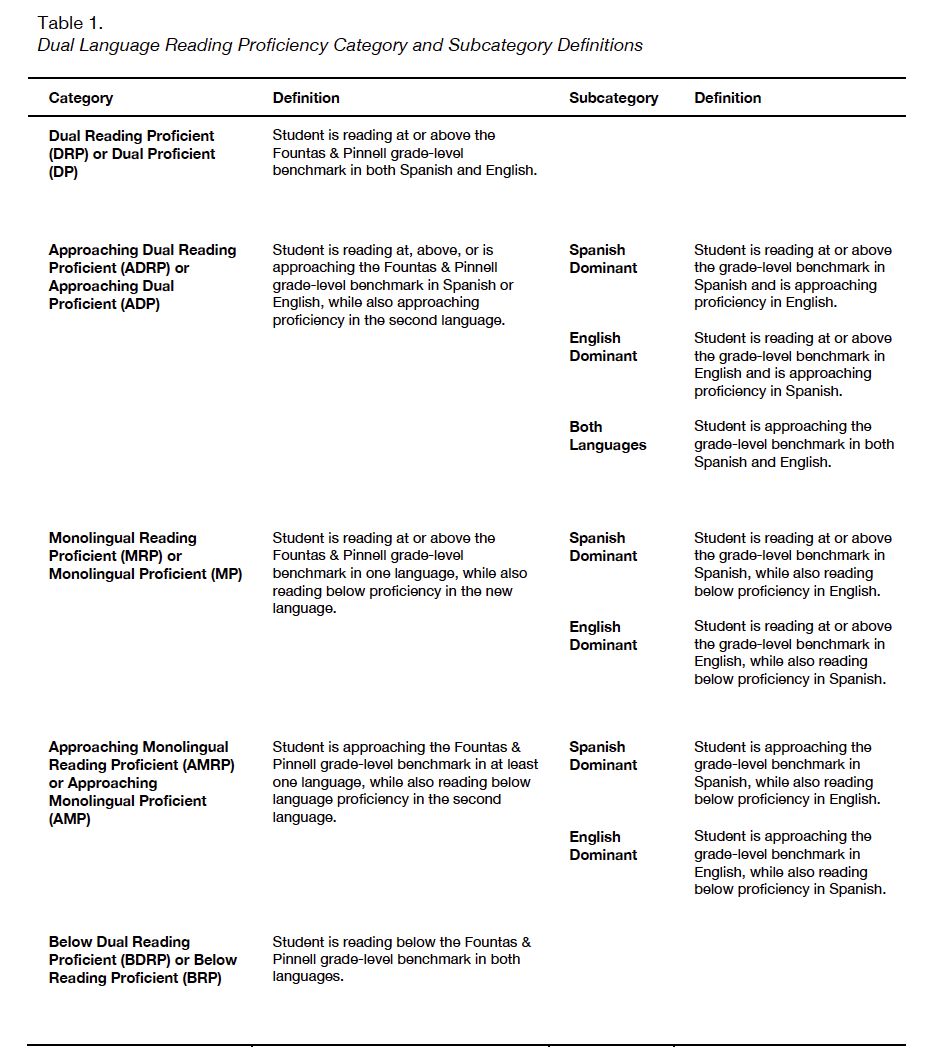
Teachers input the data as a Spanish band variable (reading in Spanish below, approaching, at, or above grade-level benchmark) and English band variable (reading in English below, approaching, at, or above grade-level benchmark) using a learning management system (LMS). A staff member then uses the raw reading data in both languages to create a dual language reading proficiency band, which is composed of the following meta-categories: Dual reading proficient, Approaching reading dual proficient, Monolingual reading proficient, Approaching monolingual reading proficient, and Below dual reading proficient. See Table 1 for a list of meta-categories and subcategories including definitions.
The dual language reading proficiency band was developed using Grosjean’s (1998) complementarity principle, which states that bilingual and multilingual students adapt a variety of languages to a context and also activate their language processing mechanisms according to whether the person, artifact, or space they are interacting with is in a monolingual or hybridized context. In a hybridized context, language users use multiple languages fluidly while also exploring the relationship between them (Hadi-Tabassum, 2006). Thus, bilinguals and multilinguals find themselves at various points on the continuum; they can be at one end of the continuum, in a monolingual language mode; at the other end of the continuum, in a bilingual or multilingual language mode; or at intermediary points depending with whom they are talking to and the context they find themselves in (Grosjean, 1989; 1998; Grosjean & Li, 2013). When bilingual and multilingual language users are in a monolingual mode, they “deactivate” their language as best they can (Grosjean, 1989), but if they choose to, and the context permits, they can move closer to a bilingual or multilingual mode and draw from their linguistic repertoire.
The reading data was collected from bilingual and multilingual students enrolled in a dynamic DLI program, so the dual language reading proficiency band functions within a dynamic bilingual context. The dual language reading proficiency band is the school’s attempt to begin to represent a more holistic portrait of a bilingual or multilingual reader.
References
Fountas, I. C., & Pinnell, G. S. (2011). Field study of reliability and validity for sistema de evaluación de la lectura, grados K–2, niveles A–N. Portsmouth, NH: Heinemann.
Fountas, I. C., & Pinnell, G. S. (2012). Field study of reliability and validity of the Fountas & Pinnell benchmark assessment systems 1 and 2. Portsmouth, NH: Heinemann.
Grosjean, F. (1989). Neurolinguists, beware! The bilingual is not two monolinguals in one person. Brain and Language, 36(1), 3-15.
Grosjean, F. (1998). Studying bilinguals: Methodological and conceptual issues. Bilingualism: Language and Cognition, 1(02), 131-149.
Grosjean, F. & Li, P. (2013). The psycholinguistics of bilingualism. Malden, MA: Blackwell Publishing.
Hadi-Tabassum, S. (2006). Language, space and power: A critical look at bilingual education. Clevedon, England: Multilingual Matters.
List of Self-Assessment Routines:
Reading Data Analyzed by Students in Second to Fifth Grade
Collected Daily
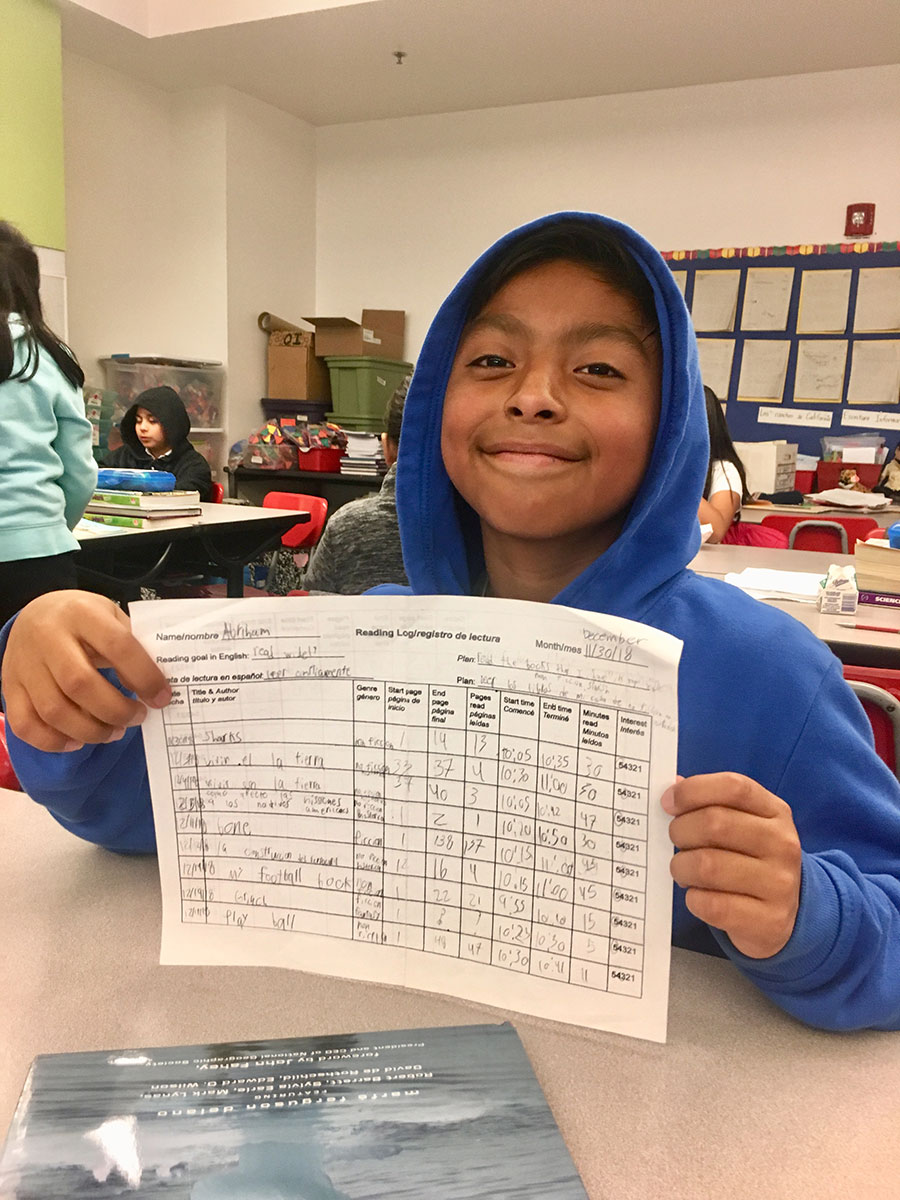
Reading Logs (Second to Fifth Grade)
An artifact used by students to keep track of the books they read.
Collected Monthly
Monthly Reading Reflections (Second & Third Grade)
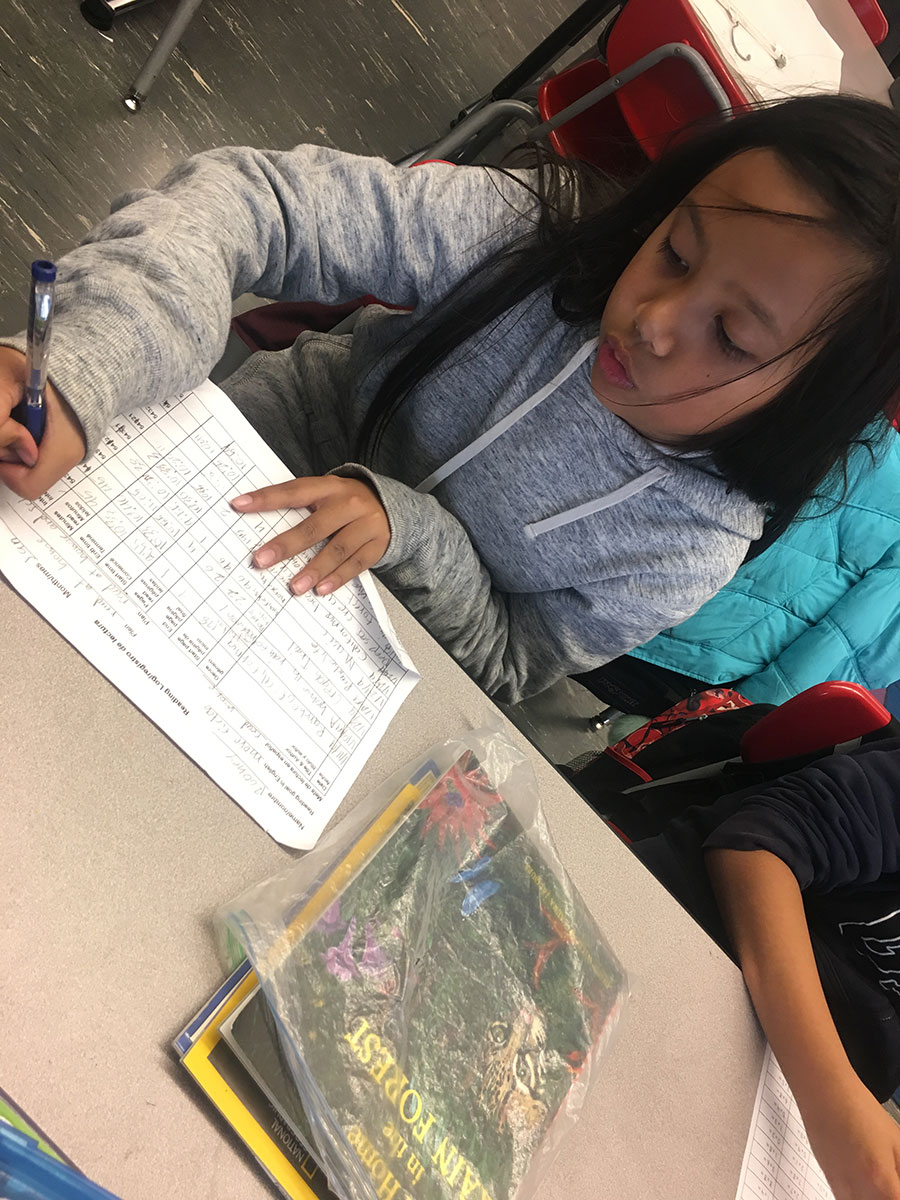

Trimester Reading Log Reflections (Fourth & Fifth Grade)
A self-assessment routine that encourages students to practice using their reading log as a data gathering tool, analyze data, and write their findings.
Collected 3 Times a Year
Draw Longitudinal Bar Graphs (Second to Fifth Grade)
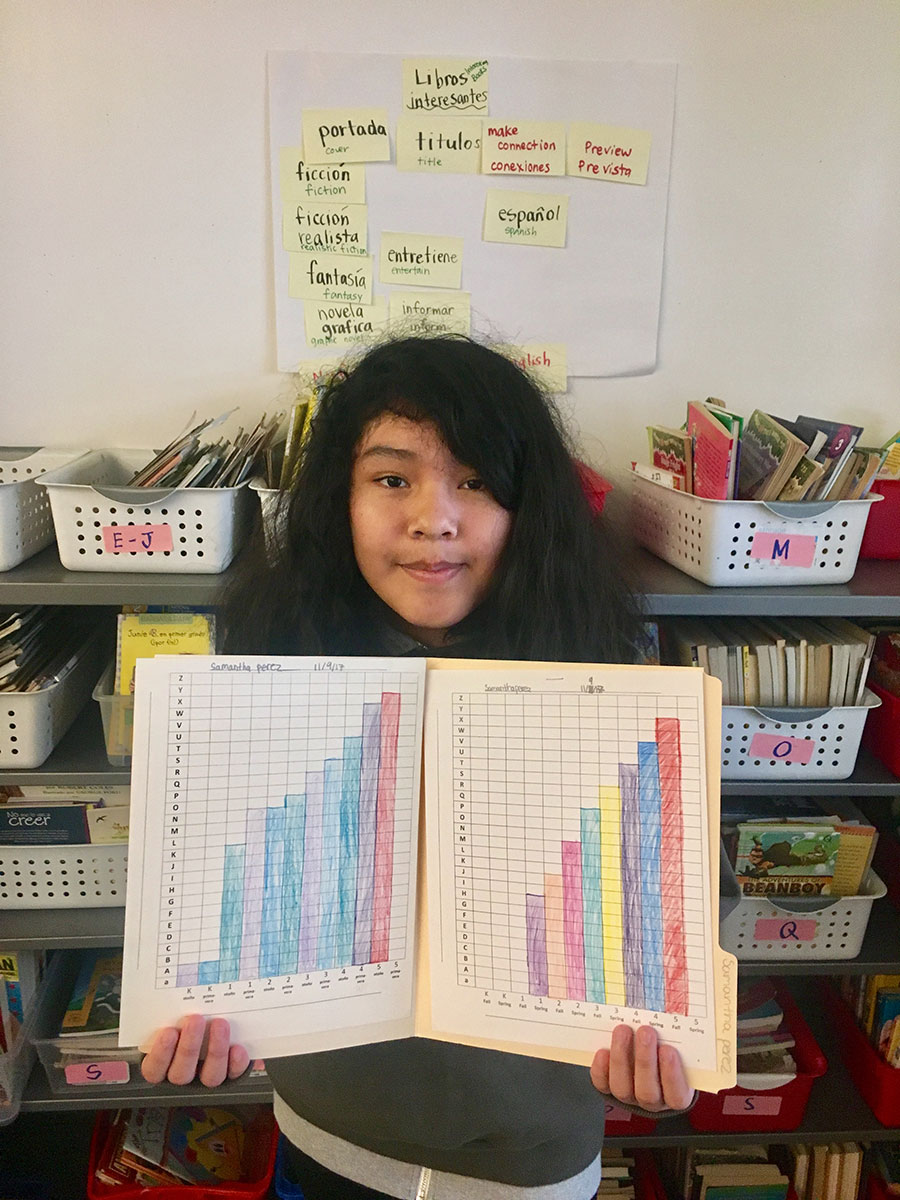
It was important for teachers to exclude a benchmark line on the bar graph template. Without a benchmark line or identifier, all students were able to celebrate their growth.
Analyze Spanish and English Reading Growth (Second to Fifth Grade)
Biliteracy Reading Reflections (Second to Fifth Grade)
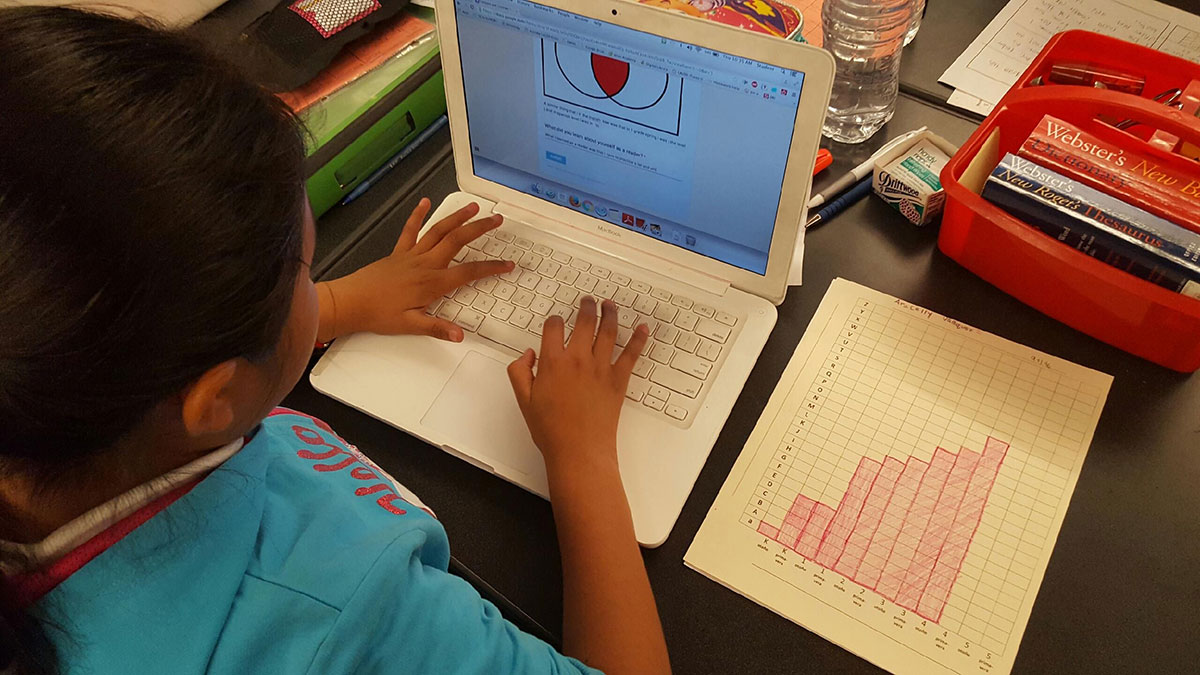
Set and Revise Reading Goals (Second to Fifth Grade)
The routines above are part of the RISA series. To complete each self-assessment piece, students use reflections gathered from classroom self-assessment routines, such as reading log reflections.
Twice a Year
Spanish and English Reading Assessment (Second to Fifth Grade)
Teachers assess students using the F & P Benchmark Assessment System (K – 5) and Sistema (K – 2), as well as the Evaluacion de la lectura en Español (3 – 5).
Parent-Student-Teacher Conferences (Second to Fifth Grade)

Teachers and students use artifacts from the RISA series to engage parents.
In 2015, teachers shared their thoughts on using this tool during parent-student-teacher conferences:
“Good tool and conversation starter.”
“Kids explained the graph. It was a really good example of a student led conversation. Students were in control. I just sat and watched the conversation.”
“Used it at an IEP meeting. It helped with the harder conferences. [It helped] explain the gap, measured against the grade-level, but [it also showed] progress. It made it concrete. Before, I would use a book bag.”
Co-Regulating Learning: How Did Teachers Help Students Self-Assess?
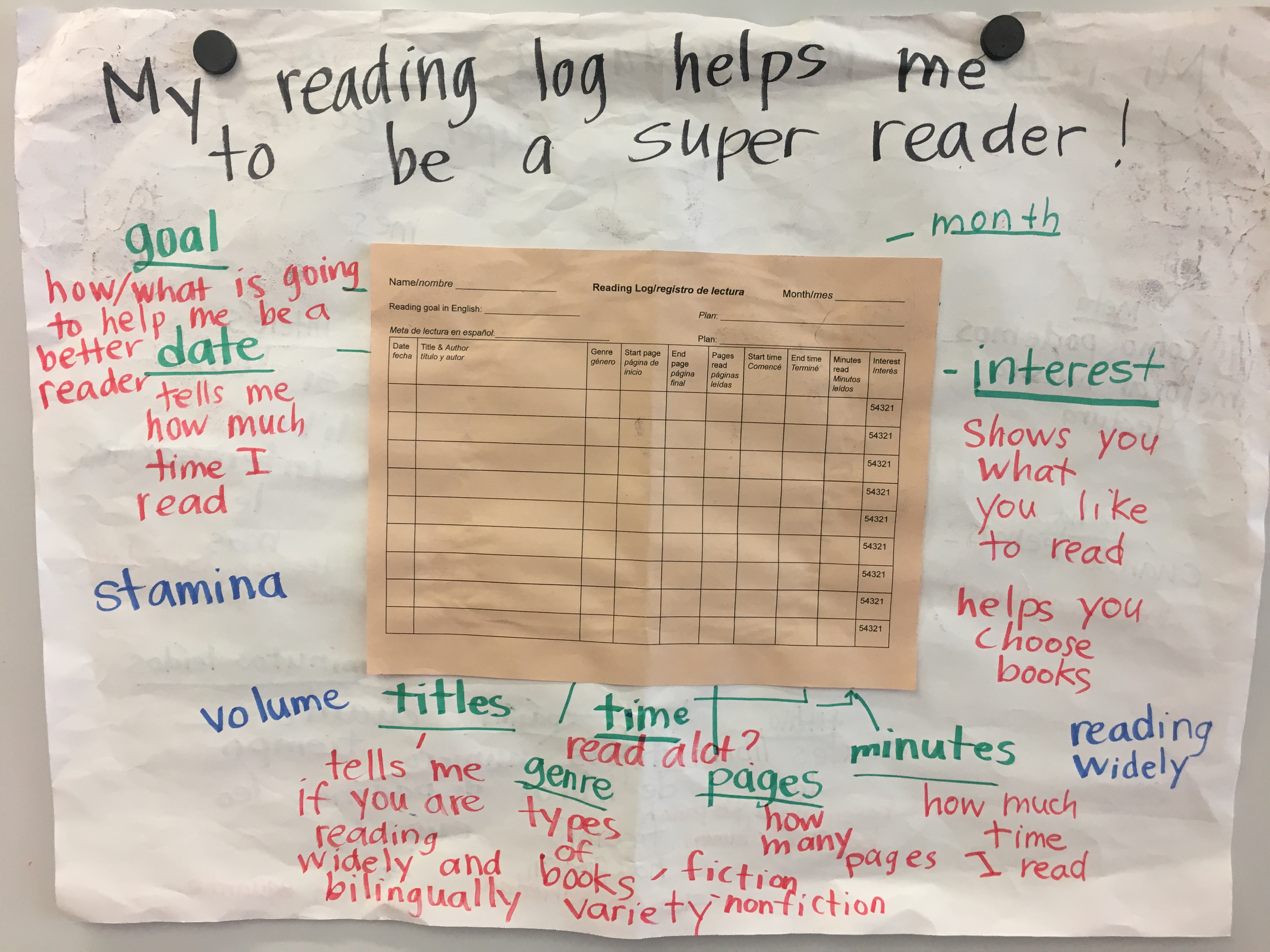
After analyzing students’ responses from the RISA, teachers found that they needed to model (co-regulate) language and content knowledge specific to the RISA in order to prepare students for the RISA. Students were taught reading behaviors, reflection practices and goal-setting explicitly as part of their reading instruction. In addition, students received support with using reading logs so when they self-assessed they could use data from their reading logs to create concrete and measurable plans. The teacher-researcher partnership found that using the reading log allowed students to collect data about their reading behavior: how long they read for (stamina), how much they read (volume), what they chose to read (interest), and what kind of books they read (reading widely). The reading log data provided students with evidence of their reading regulation (engagement), and assisted students as they managed their Spanish and English reading goals and plans.
Students Found Self-Assessment Routines Helpful
The teacher-researcher partnership found that students believed the RISA routines about goal setting and planning were helpful, whether they met their Spanish and English reading level goals. In other words, students reported benefiting from routines that helped them self-assess. These findings are supported by research: Self-assessment significantly impacts student learning if students are systematically taught how to self-assess (Ramdass & Zimmerman, 2008) and if self-assessment is a fixture of the classroom’s microculture (e.g., social and academic-disciplinary norms and practices) (Cerda, Bailey, & Heritage, under review). See RISA findings on goal setting and planning, Figures 2 – 5, for more information.
Student Reflection Deepened Over Time
Self-assessment responses became more thoughtful over an academic year and across grade levels. See Emily’s Student Profile for an example.
The DLI Program Improved
Since teachers began administering the RISA, the percentage of students reading at grade level in Spanish and English has increased across student cohorts (grades K – 5). Although this change may be due to a multitude of classroom- and individual- level factors, we cannot rule out the possibility that students’ and teachers’ participation with the RISA and its routines may have had an impact.
Student Profile
Goal Setting: “I am going to read in two languages so that I can improve my reading levels…”
Emily
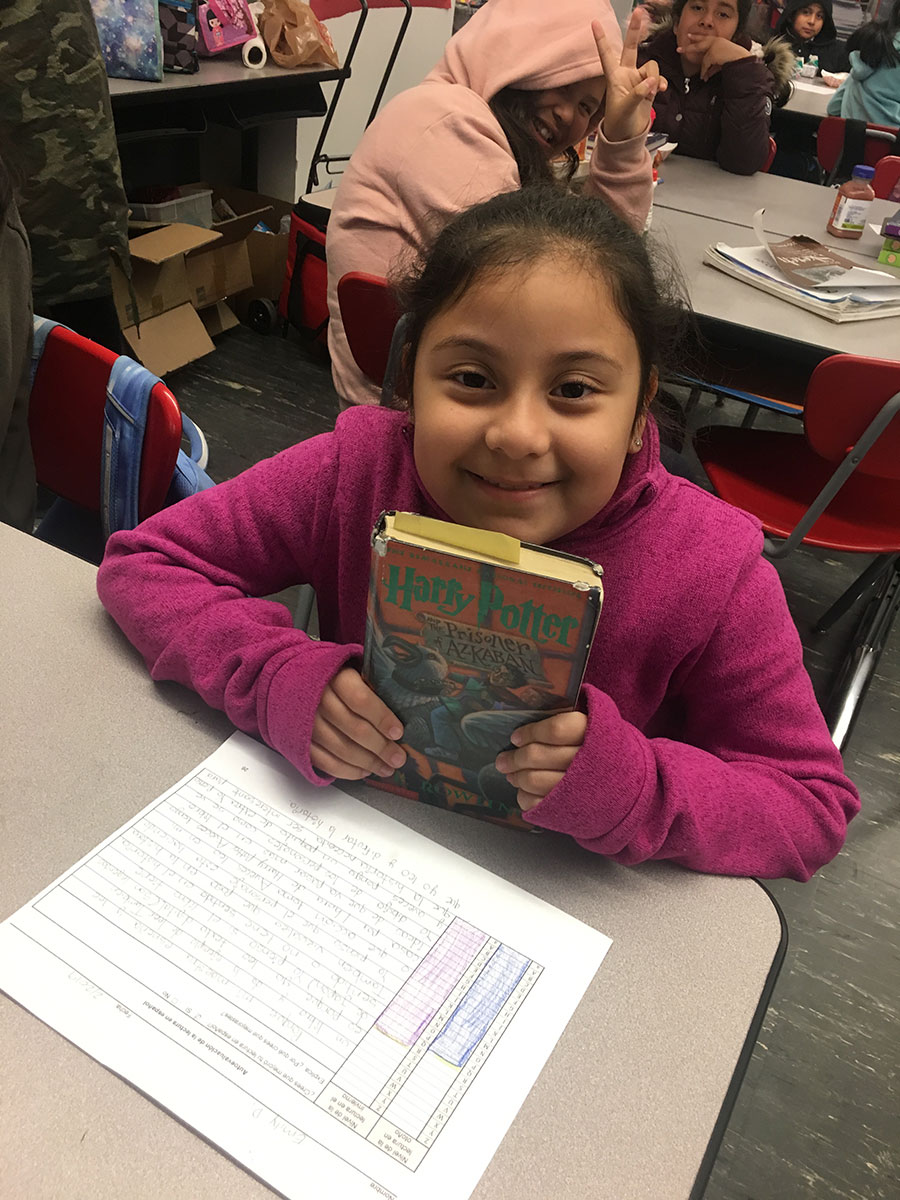
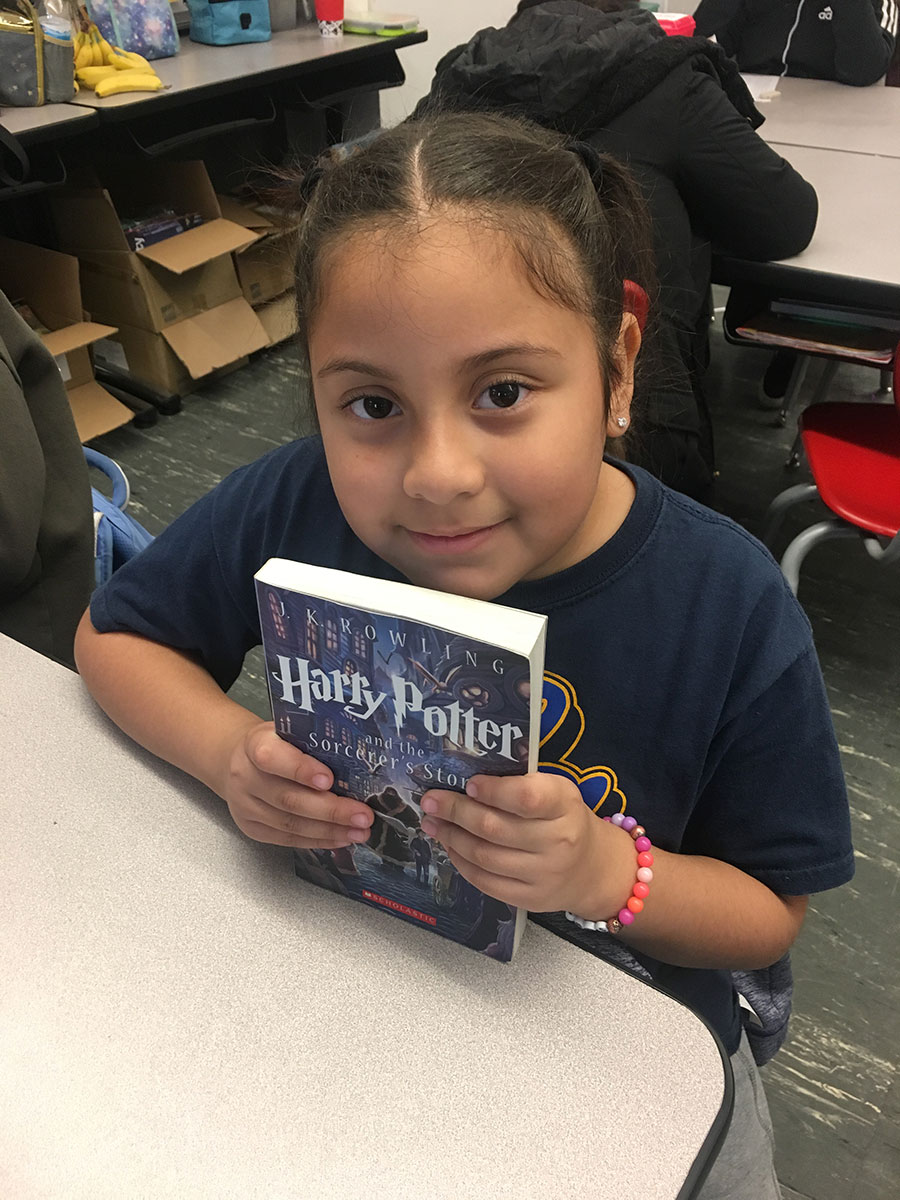
Emily is a 9 year old student at UCLA Community School in Los Angeles. Her parents are immigrants from Central America, Honduras and El Salvador. She enjoys drawing and reading fantasy.
Emily’s Self-Assessment in Chronological Order, Second to Fourth Grade
Text was originally written in Spanish and was translated in English for this brief.
Second Grade: 2016 – 2017
Emily graphs her longitudinal Spanish and English reading data. She then analyzes her data.
“Yo aprendí que yo estaba más alta en inglés y en español estaba más abajo que inglés.”
English Translation: “I learned that I was higher in English and in Spanish I was lower than in English.”
She sets reading goals.
“Mi meta es que voy a leer en la noche.”
English Translation: My goal is that I will read at night.
At the end of second grade. She evaluates her yearly progress with reading in Spanish and English.
“Porque leía por 3 días. Yo leo cuando esta silencio. Yo leo cuando mi hermanita duerme. Yo me gusta los libros de ficción y no ficción. Leía en inglés y en español. Leo 10 minutos. Estudio palabras.”
English translation: “[My reading levels went up] because I read for 3 days. I read in silence. I read when my little sister sleeps. I like to read books of fiction and nonfiction. I read in English and Spanish. I read 10 minutes. I study words.”
Third Grade: 2017 – 2018
Emily enters third grade. She updates her longitudinal Spanish and English bar graph and analyzes her data. She sets a reading goal.
“Aclarar cuando estoy leyendo libros. Y voy a visualizar.”
English Translation: “To clarify when I am reading books. And I am going to visualize.”
After the holidays, she evaluates her Spanish and English reading progress using her reading log.
“Yo leo en mi casa 10 minutos. Yo voy a la biblioteca a agarrar mis libros. Yo uso mi registro para mejorar mi lectura. Yo cuento mis libros en registro. Yo leo libros interesantes. En mi meta quiero subir a nivel R o U. Yo voy a leer más en los dos lenguajes. Voy a practicar como estoy en P.E. y en casa. Yo leo mis libros a mi nivel en casa. Yo leo no es mi nivel. Cuando estoy en R mi otra meta es a subir a nivel ‘V’ y ‘W’.”
English Translation: “I read in my house 10 minutes. I go to the library to get my books. I use my log to improve my reading. I count my book on my log. I read interesting books. In my goal I want to go to a level R or U. I am going to read more in two languages. I am going to practice practice like P.E. and at home. I read my leveled books at home. I read not at my level. When I am at R, my other goal will be to go up to level V and W.
At the end of third grade, she evaluates her yearly progress with reading in Spanish and English.
“Aprendí que me gusta leer [libros de] capítulo…A mi me gusta leer biografías. También, me encanta leer historias reales. Cuando leo historias, tengo interés… Voy a leer dos idiomas para subir niveles… Me ayuda mi registro recordar que libros me gustan. A lo mejor puedo leer dos al día.”
English Translation: “I learned that I like to read chapters… I like to read biographies. Also, I like to read real stories. When I read stories, I am interested… I am going to read in two languages so that I can improve my reading levels… My log helps me remember which books I like. Maybe I can read two a day.”
Fourth Grade: 2018 – 2019
Emily enters fourth grade. She updates her longitudinal Spanish and English bar graph and analyzes her data. She sets a reading goal.
“Mi meta es aprender más vocabulario porque casi no entiendo a mi mama que dice ellas. Y quiero aprender más vocabulario en español porque quiero entender más palabras en libros. Quiero leer con aguante porque no estar distraída de otras cosas, y para subir mi nivel y para que leo más.”
English Translation: “My goal is to learn more [Spanish] vocabulary because I don’t understand what my mom says. And I want to learn more Spanish vocabulary to understand words in books. I want to read with stamina because I don’t want to be distracted with things, and to raise my level so I can read more.”
After the holidays, she evaluates her Spanish and English reading progress.
“Si mejore mi lectura…Yo pienso si el libro tiene sentido o no tiene sentido [cuando lo leo]. También visualizo que pasa en la historia…A veces leo en mi casa por 1 hora Harry Potter. A veces tengo ideas de lo que va a pasar más en el libro.. Dibujo los personajes…y a veces pongo un poquito extra [y hago inferencias]. Yo pienso que historias [cuentos] necesitan ser interesante para que yo le[a] y disfrut[e] la historia.”
English Translation: “I did improve my reading… I think about whether the book is making sense or not [as I read it]. Also, I visualize what is happening in the story. Sometimes, I read Harry Potter at home for an hour. Sometimes, I have ideas about what might happen in the book…. I draw the characters…. and sometimes I put a little extra [and make inferences]. I think that the story needs to be interesting so I can read and enjoy they story.”
Emily’s reflections – grades 2 – 4
Student Profile
Goal Setting: “I am going to read in two languages so that I can improve my reading levels…”
Emily
Emily is a 9 year old student at UCLA Community School in Los Angeles. Her parents are immigrants from Central America, Honduras and El Salvador. She enjoys drawing and reading fantasy.
Emily’s Self-Assessment in Chronological Order, Second to Fourth Grade
Text was originally written in Spanish and was translated in English for this brief.
Second Grade: 2016 – 2017
Emily graphs her longitudinal Spanish and English reading data. She then analyzes her data.
“Yo aprendí que yo estaba más alta en inglés y en español estaba más abajo que inglés.”
English Translation: “I learned that I was higher in English and in Spanish I was lower than in English.”
She sets reading goals.
“Mi meta es que voy a leer en la noche.”
English Translation: “My goal is that I will read at night.”
At the end of second grade. She evaluates her yearly progress with reading in Spanish and English.
“Porque leía por 3 días. Yo leo cuando esta silencio. Yo leo cuando mi hermanita duerme. Yo me gusta los libros de ficción y no ficción. Leía en inglés y en español. Leo 10 minutos. Estudio palabras.”
English translation: “[My reading levels went up] because I read for 3 days. I read in silence. I read when my little sister sleeps. I like to read books of fiction and nonfiction. I read in English and Spanish. I read 10 minutes. I study words.”
Third Grade: 2017 – 2018
Emily enters third grade. She updates her longitudinal Spanish and English bar graph and analyzes her data. She sets a reading goal.
“Aclarar cuando estoy leyendo libros. Y voy a visualizar.”
English Translation: “To clarify when I am reading books. And I am going to visualize.”
After the holidays, she evaluates her Spanish and English reading progress using her reading log.
“Yo leo en mi casa 10 minutos. Yo voy a la biblioteca a agarrar mis libros. Yo uso mi registro para mejorar mi lectura. Yo cuento mis libros en registro. Yo leo libros interesantes. En mi meta quiero subir a nivel R o U. Yo voy a leer más en los dos lenguajes. Voy a practicar como estoy en P.E. y en casa. Yo leo mis libros a mi nivel en casa. Yo leo no es mi nivel. Cuando estoy en R mi otra meta es a subir a nivel ‘V’ y ‘W’.”
English Translation: “I read in my house 10 minutes. I go to the library to get my books. I use my log to improve my reading. I count my book on my log. I read interesting books. In my goal I want to go to a level R or U. I am going to read more in two languages. I am going to practice practice like P.E. and at home. I read my leveled books at home. I read not at my level. When I am at R, my other goal will be to go up to level V and W.
At the end of third grade, she evaluates her yearly progress with reading in Spanish and English.
“Aprendí que me gusta leer [libros de] capítulo…A mi me gusta leer biografías. También, me encanta leer historias reales. Cuando leo historias, tengo interés… Voy a leer dos idiomas para subir niveles… Me ayuda mi registro recordar que libros me gustan. A lo mejor puedo leer dos al día.”
English Translation: “I learned that I like to read chapters… I like to read biographies. Also, I like to read real stories. When I read stories, I am interested… I am going to read in two languages so that I can improve my reading levels… My log helps me remember which books I like. Maybe I can read two a day.”
Fourth Grade: 2018 – 2019
Emily enters fourth grade. She updates her longitudinal Spanish and English bar graph and analyzes her data. She sets a reading goal.
“Mi meta es aprender más vocabulario porque casi no entiendo a mi mama que dice ellas. Y quiero aprender más vocabulario en español porque quiero entender más palabras en libros. Quiero leer con aguante porque no estar distraída de otras cosas, y para subir mi nivel y para que leo más.”
English Translation: “My goal is to learn more [Spanish] vocabulary because I don’t understand what my mom says. And I want to learn more Spanish vocabulary to understand words in books. I want to read with stamina because I don’t want to be distracted with things, and to raise my level so I can read more.”
After the holidays, she evaluates her Spanish and English reading progress.
“Si mejore mi lectura…Yo pienso si el libro tiene sentido o no tiene sentido [cuando lo leo]. También visualizo que pasa en la historia…A veces leo en mi casa por 1 hora Harry Potter. A veces tengo ideas de lo que va a pasar más en el libro.. Dibujo los personajes…y a veces pongo un poquito extra [y hago inferencias]. Yo pienso que historias [cuentos] necesitan ser interesante para que yo le[a] y disfrut[e] la historia.”
English Translation: “I did improve my reading… I think about whether the book is making sense or not [as I read it]. Also, I visualize what is happening in the story. Sometimes, I read Harry Potter at home for an hour. Sometimes, I have ideas about what might happen in the book…. I draw the characters…. and sometimes I put a little extra [and make inferences]. I think that the story needs to be interesting so I can read and enjoy they story.”
RISA Findings
Goal Setting and Planning for Spanish and English Reading
Every Spring, after completing the final RISA reflection in Spanish and then in English, fourth and fifth grade students rate how helpful a variety of RISA activities about goal-setting and planning are to them as readers of either language using a 4-item scale. Items are rated on a 5-point likert scale, 1 = not very helpful to 5 = extremely helpful, including a we did not do this in my class response option. Items about Spanish reading are written in Spanish and items about English reading are written in English.
Did students meet their English reading goal? What RISA routines did they find most helpful?
About three quarters (73%, n = 142) of the 195 students said they did meet their English reading level goal. Teacher-researcher partners analyzed students’ survey responses to identify which RISA routines helped them meet their goal.
Overall, these 142 students found the following RISA routines about goal-setting and planning helpful when reading in English (see Figure 2): Creating an English reading level goal (72%, n = 102) and Practicing the reading behavior they chose (75%, n = 106). Less students, however, found Identifying which reading behavior to practice (65%, n = 92) and Choosing a strategy to practice a reading behavior (65%, n = 92) helpful.

Figure 2. Students, who did meet their English reading level goal, found the following routines helpful when reading in English.
About a quarter (27%, n = 53) of the 195 students said they did not meet their English reading level goal. We analyzed their survey responses about what RISA routines they found helpful even though they did not meet their reading goal.
Overall, these 53 students found the following RISA routines about goal-setting and planning helpful when reading in English (see Figure 3): Creating an English reading level goal (77%, n = 41), Identifying which reading behavior to practice (70%, n = 34), and Practicing the reading behavior they chose (85%, n = 45). Less students, however, found Choosing a strategy to practice a reading behavior (64%, n = 37) helpful.
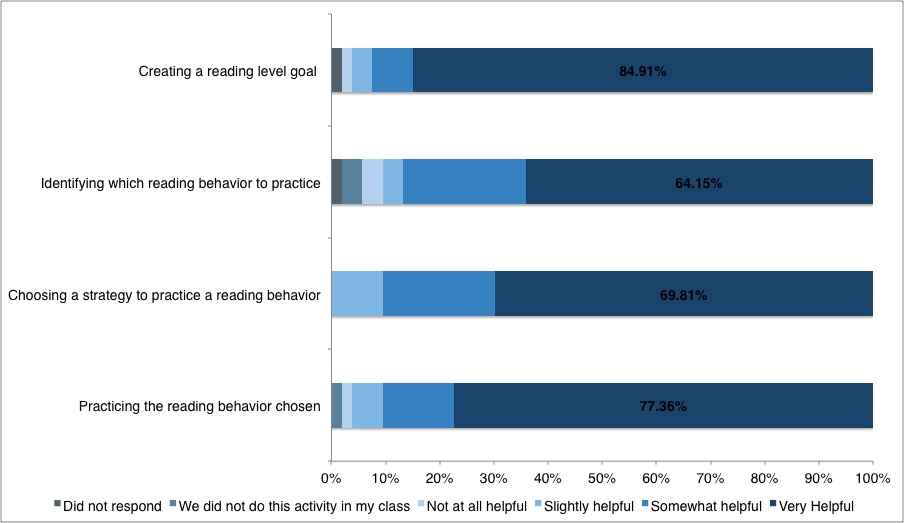
Figure 3. Students, who did not meet their English reading level goal, found the following routines helpful when reading in English.
Did students meet their Spanish reading goal? What RISA routines did they find most helpful?
About two thirds (64%, n = 119) of the 186 students said they did meet their Spanish reading level goal. Teacher-researcher partners analyzed students’ survey responses about what RISA routines helped them meet their goal.
Overall, these 119 students found the following RISA routines about goal-setting and planning helpful (see Figure 4): Creating a reading level goal (77%, n = 92), Identifying which reading behavior to practice (72%, n = 86), and Choosing a strategy to practice a reading behavior (69%, n = 82). Less students, however, found Practicing the reading behavior chosen (63%, n = 75) helpful.
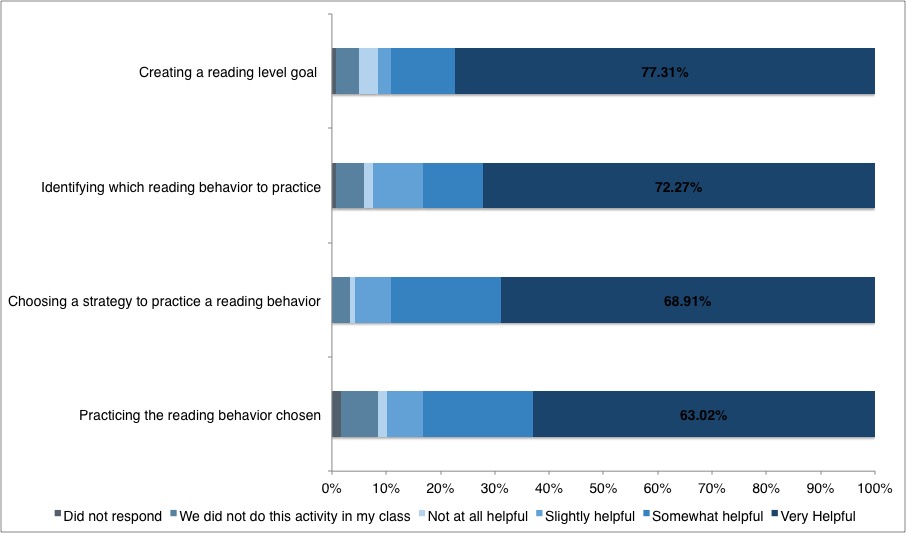
Figure 4. Students, who did meet their Spanish reading level goal, found the following routines helpful when reading in Spanish.
About one third (37%, n = 67) of the 186 students said they did not meet their Spanish reading level goal. Teacher-researcher partners analyzed students’ survey responses about what RISA routines they found helpful even though they did not meet their reading goal.
Overall, these 67 students found most of the RISA routines about goal-setting and planning helpful (see Figure 5): Creating a reading level goal (75%, n = 50), Choosing a strategy to practice a reading behavior (73%, n = 49), and Practicing the reading behavior chosen (63%, n = 42). By comparison, less students (55%, n = 37) found the following routine helpful: Identifying which reading behavior to practice.
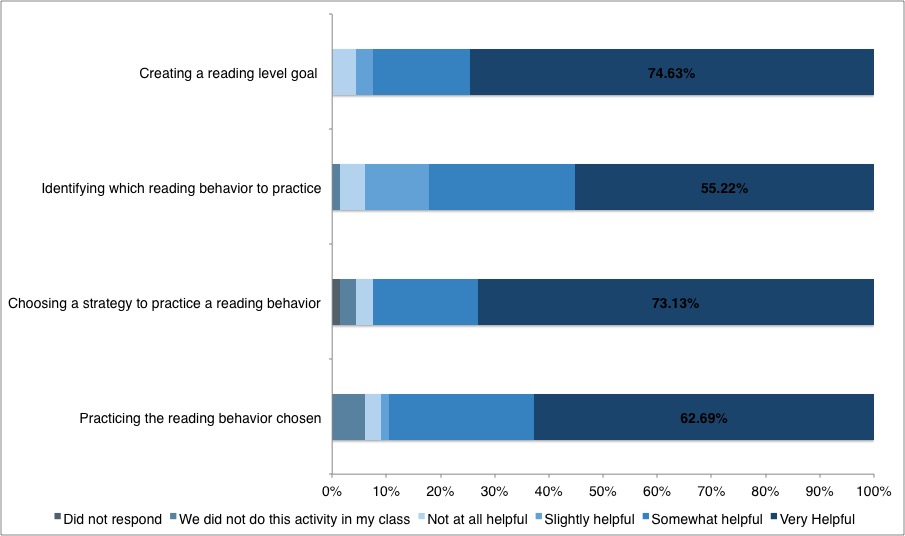
Figure 5. Students, who did not meet their Spanish reading level goal, found the following routines helpful when reading in Spanish.
In sum, students who did meet (and did not meet) their Spanish and English reading level goals believed that the RISA routines were helpful. Further descriptive data analysis is recommended in order to determine which students (who did meet or did not meet their goals) are reading at grade level in both languages. Teacher-researcher partners would like to further examine to what degree students made progress (i.e., the number of reading levels they passed moving them closer to grade level expectations) in order to confirm their hypothesis: Students, who did not meet their reading-level goal, but who reported that the RISA routines were helpful in either language, did indeed observe reading growth.
Teacher-researcher partners recommend that students, overall, may benefit from exposure to scaffolds and instructional or peer supports that demonstrate how the RISA routines highlighted here help students create and execute a goal setting plan, especially with regards to practicing the reading behavior chosen, Identifying which reading behavior to practice and Choosing a strategy to practice a reading behavior. They recommend instructors confer with students in partnerships, groups or whole class settings in order to determine how students are interpreting and executing the routines during independent practice. They also recommend modifying and/or differentiating instruction to further support students’ goal setting and planning skills.
RISA Findings
Has the RISA helped students become proficient readers of Spanish and English?
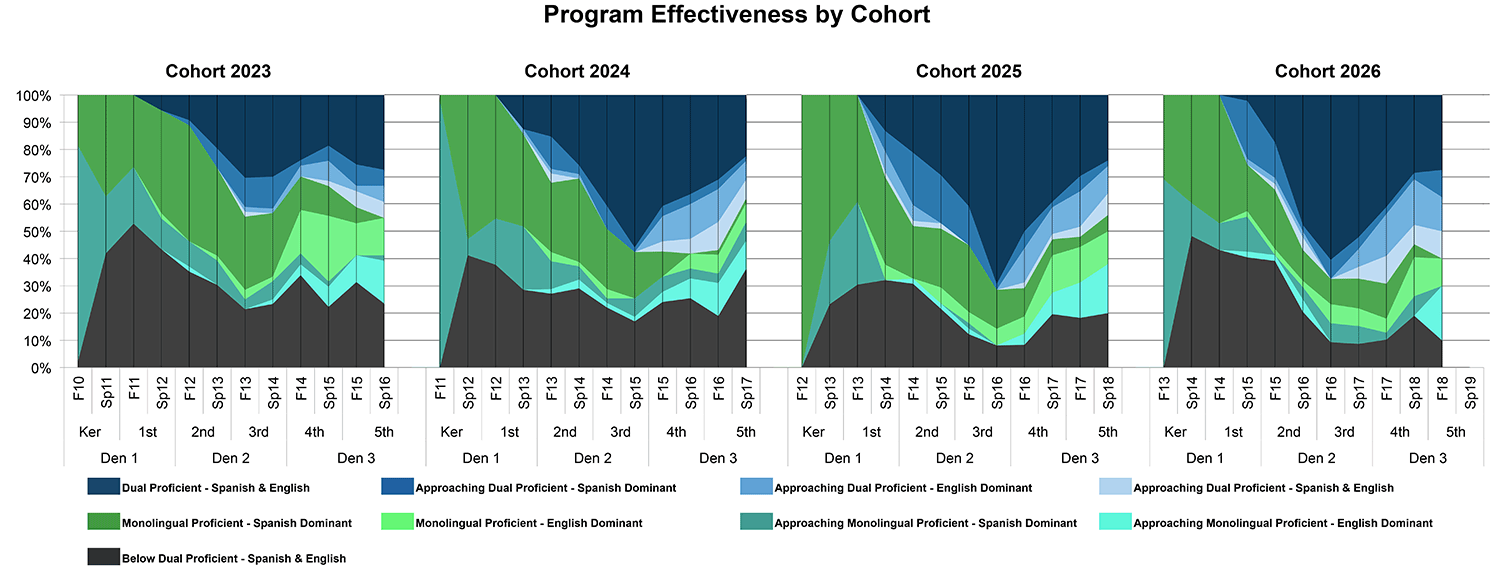
Figure 6. Area Cohort Chart
Note. Each area chart represents a student cohort from Kindergarten through 5th grade. Students’ English reading is tested in the end of the first-grade year. Thus, students dual reading proficiency is not accounted for until the end of the first grade. Every fourth and fifth grade student in Cohort 2023, 2024, 2025, and 2026 completed the RISA in their classroom. Next year, students in Cohort 2027 will be the first students to have completed the RISA since second grade.
This data visualization illustrates to what degree different cohorts developed reading in Spanish and English as they progressed through the program. The legend represents a dual language reading proficiency band composed of the following meta-categories: dual reading proficient, approaching reading dual proficient, monolingual reading proficient, approaching monolingual reading proficient, and below dual reading proficient. Refer to Table 3 for a list of meta-categories and subcategories including definitions. The dual language reading proficiency band is the school’s attempt to begin to represent a more holistic portrait of a bilingual reader (i.e., a student who is learning to read their home language and English at school) and a multilingual reader (i.e., a student who is learning to read Spanish and English as a second or third language). Reporting the data in this way also helps teachers and school leaders analyze the effectiveness of the bilingual program.
Teacher-researcher partners found that the percentage of second and third grade students (in Cohorts 2023, 2024, & 2025), who were reading at or above proficiency in Spanish and English (i.e., Dual Reading Proficient, DRP), appeared to increase over time. Additionally, they noticed that after the third grade, the percentage of DRP students (in Cohorts 2023, 2024, & 2025) began to drop and continued on a downward trajectory in the fourth and fifth grades. However, a change is occurring in Cohort 2026: The percentage of students, who are DRP, increased at the end of the third grade, sooner than other cohorts, and the percentage of DRP students from fourth to fifth grade remains stable, indicating that perhaps more students are now maintaining dual reading proficiency after the fourth grade in greater numbers than before.
The Multilingual Interdisciplinary Social Action (MISA) Project: Emerging Trends
Students Explored and Analyzed a Current Local Issue
The social studies teachers guided their students to investigate various social issues at the local and national levels. For example, in the 8th, 9th and 12th grade, students explored the social issues of homelessness in their community–Koreatown. The issue was particularly salient because in the Spring of 2018 the community was debating whether they should build a homeless shelter in the heart of the Koreatown community. As part of the project students heard from experts from different community organizations about the causes of homelessness in Los Angeles and upon getting a better understanding of the issue, students even participated in local rallies and protests in support of the proposed homeless shelter.
Students learned of the multifaceted causes of homelessness in Los Angeles through their research from various primary and secondary sources and the community data they collected from their classmates and families about homelessness. Students presented their findings to families and students at the Social Studies Department’s Annual History Day, and then subsequently, completed the MISA Self-Assessment. The student self-assessment was designed to measure how students’ sense of identity, language, and relationship to social action changes over time for a given project. Teachers used students’ self-assessment to modify their curriculum and instruction to support student growth in these areas. Refer to the MISA Self-Assessment Student Profiles for three examples of student reflections.
Student Profiles
Below are three students’ responses to the MISA Self-Assessment from Spring 2018. Their responses illustrate what they learned while studying homelessness, as well as document their thoughts about aspects of their project (e.g., managing tasks and communicating using a variety of languages).
Alex |
Patricia |
Kleber |
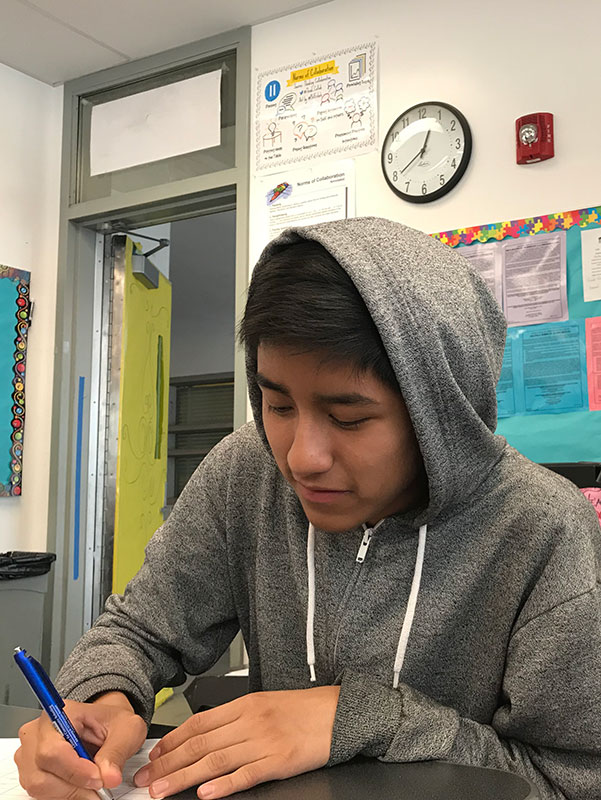 |
|
 |
“No matter what I become I will always try to help…people.” |
“I want to stand up for what I believe in.” |
“It is very important to communicate in more than one language, to be able to understand other people’s ideas and thoughts.” |
Alex’s Self-Assessment (Eighth Grade) |
Patricia’s Self-Assessment (Eighth Grade) |
Kleber’s Self-Assessment (Ninth Grade) |
Before beginning this project, what did you think about homelessness? |
||
| Before starting this project, I thought that houselessness was not a major problem. Now that I have more information about this topic, I am able to understand more. Having information about this topic allows me think of solutions to this problem. | Growing up I would hear the adults around me telling other kids to be serious with their education or they’ll end up being homeless like the people on the streets. They would always say, “Don’t be lazy. Do you want to end up like the people sleeping on the streets?” I knew before that homeless people weren’t just lazy and that they had jobs before they became homeless. It’s somewhat disappointing knowing that that’s what people think of them. I knew that houselessness will become more and more common to other places if no one does anything to stop it. | What I thought about houselessness before beginning this project was that the only causes of houselessness [were] drugs and alcohol. I also thought that most houseless people had a mental illness, but that is not true. Also, I thought that there were not many causes of houselessness. |
What do you think now? Why? |
||
| I think that houselessness will keep on being a major issue. It will just keep on growing and growing if we don’t put a stop to it. I think that everyone should know about this issue so that they can be aware of it. | I’m not surprised with the results because I knew them before this project. I knew that most homeless people have had jobs before and that minimum wage got to them. Now I know what people think of it, too. Through the surveys, I learned about what they believe is the reason why homelessness exists. I still think that homelessness will become more and more common if people will just sit there and ignore what’s happening in the world outside. | What I think now is that many houseless people are suffering due to many causes that not a lot of people know about. What I also think right now is that gentrification is hurting a lot of poor people that is causing them to leave their homes and live in the streets. |
What went well? Why? |
||
| Something that went well was that I got to present to older people. I got their point of view and attempted to understand it. I was also very happy to share what I knew about the topic.
|
Something that went well is that the people we surveyed actually gave some insightful responses with some questions they have and what they think is a good solution in ending homelessness. Another is that though at some point we worked on the tri-fold in the last minute, we still managed to do our presentation well, and I believe that we were able to explain the details about our topic clearly. My team also enjoyed presenting to other people, so we ended up presenting for a second time; I think that’s another thing that went well.
|
We included a lot of information about our topic. Something else that went well is that we also included other things that cause houselessness, not only gentrification.
|
What didn’t go well? Why? |
||
| What didn’t go well was the amount of time we had for making the posters and presenting it. We needed to make information shorter and detailed. Also the presentation took to long so we need to shorten it.
|
Our tri-fold was sort of dull because we printed out most of the things we put on it. We did not have enough time to work on it, so we just printed the information we had to put there and pasted it on the tri-fold. Another thing that did not go well was how our presentation was distributed among the team members. I only got to present for one section and introduced the educational tools, while my other teammates had more to say. We solved this problem, though, as I got to present for another section in the end.
|
We might not have included enough facts. Maybe this occurred because we did not have more time and we were really focused on the specific information that we had to include in our poster.
|
In what ways would you manage project tasks differently next time? |
||
| I think that maybe next time I can take the poster one day to work on it and the other day my partner can take. I can also do some of the work during my leisure time or when I am free. I can also use the time we have during class wisely and appropriately.
|
Next time, I will communicate with my teammates about working on the project more. We did not spend enough time working on it, so I’m hoping we could do that. Also, I hope we would not print out most of the things for the tri-fold. Maybe next time we could write on it more and make most of it by hand.
|
I would manage project tasks differently next time by making more time to include more information than were asked to put. Next time I would manage project tasks differently by not taking a lot of time doing things that are maybe not very related to the topic that we discuss.
|
Which languages did you use throughout the development of your project? |
||
| English, Spanish
|
English, Tagalog, Korean
|
English, Spanish
|
In what ways were you successful at communicating with different community members during the development of your project? |
||
| I think that we were somewhat successful because most of our audiences spoke English. Having the project still in Spanish was great. We did speak in Spanish a little bit but not much.
|
I interviewed them with the survey, showed them our flyer, and asked them for their thoughts on homelessness. Most of the people I interviewed gave insightful responses, and they had very good questions and solutions on how stop homelessness. Since we used three languages for our flyers, we were able to communicate with people in those languages and was very helpful to them.
|
I was successful because I was able to communicate and write in two different ways throughout the project. Another way I was successful was by explaining to others in the language of their choice about our project.
|
What would you do differently next time? Why? |
||
| I think I would manage my time better. I would also try to make the conversation a bit more interesting. I would also add more details and decorations to the poster and make the educational tool more interesting as well.
|
Maybe next time I could use more languages. For example, since there are a lot of Spanish speakers in our school, I could try to make a flyer in Spanish. I could try to talk about this with not just adults but also kids my age.
|
What I would do differently next time is add more information and get more ideas about the topic. Something else I would do differently is make more time to finish each part of the project as good as possible.
|
What did you learn about yourself as a user of one or more languages? Include as many details as you can. |
||
| I think that it is hard knowing more than one language. You have to be good at switching from one language to the other and still feel comfortable speaking. I was alright speaking both Spanish and English but I was not comfortable speaking them. I still liked the attempt I did.
|
I learned that it really is helpful to showcase something in multiple languages. Not everyone speaks English, and I think the people we showed our flyers to in the language they’re comfortable with appreciated it. I also learned more vocabulary words in the language I speak, helping me understand it more. I think being multilingual is helpful when communicating with the people around us. |
I learned that I can do a good job talking in different languages if I need to. I also learned it is very important to communicate in more than one language, to be able to understand other people’s ideas and thoughts. |
What identity or identities did you enact as you worked on your project? |
||
| A Student, A Researcher
|
A Community Member, An Activist, A Student, A Researcher
|
A Community Member, A Student, A Researcher
|
Why did you see yourself in this way? |
||
| Because I was researching about houselessness
|
I want to be able to change what people think about homelessness. I want to stop homelessness. | I see myself as this way because I did research about this topic and interviewed other people by asking [them] what they thought about the topic. |
In what ways do you think this knowledge about yourself will inform who you would like to become? |
||
| I think that no matter what I become I will always try to help out people. I think that this topic talks about different ways we can help homeless people. If we keep on thinking this way we will think of ways we can help out our communities. This knowledge has helped me realized that I like helping out people.
|
Knowing that I want to stand up for what I believe in, I could use that to actually take action. I could try to be more active in serving the community. Maybe I could educate other people about this, too. All I know is that I could use this to change the world.
|
This would inform [me about] who I would like to become because this [project] teaches people [about] who I am as a student. This would also inform me [about] who I would like to become because I am still thinking [about] what I want to be in the future.
|
Who was your audience? |
||
| Peers / Classmates, Researchers
|
Teachers, Peers / Classmates, Researchers
|
n/a |
What languages did you use to present your topic? |
||
| English, Spanish
|
English, Tagalog, Korean | n/a |
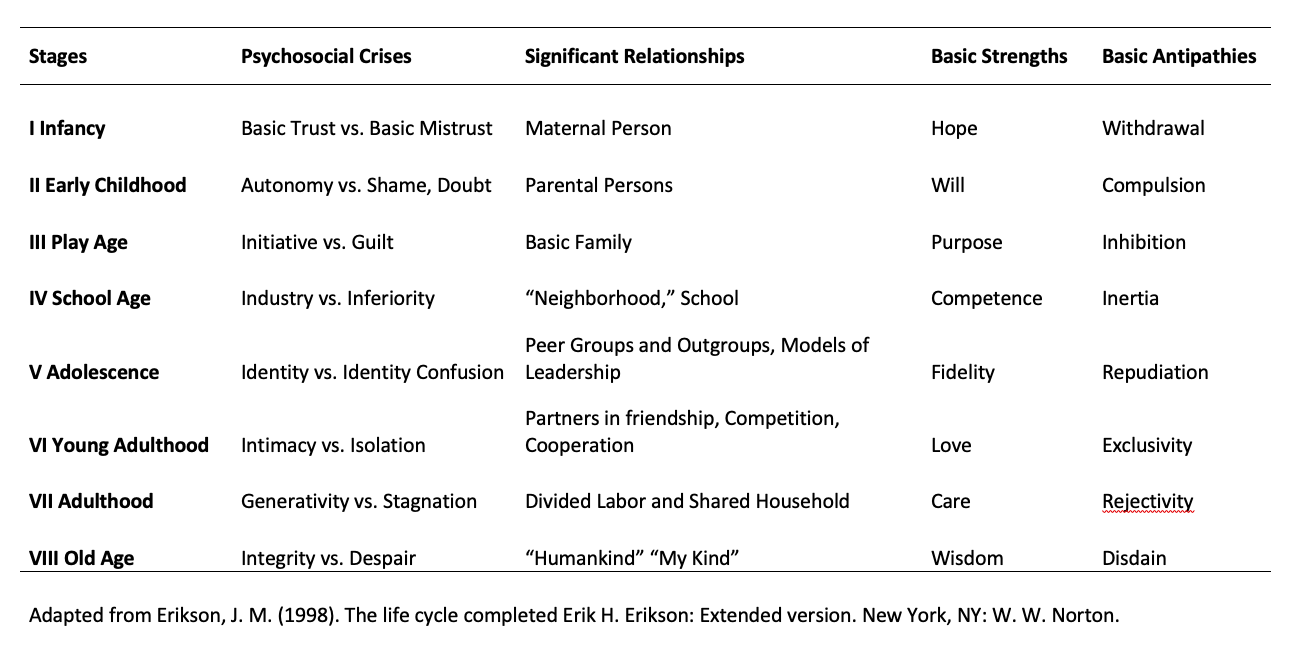
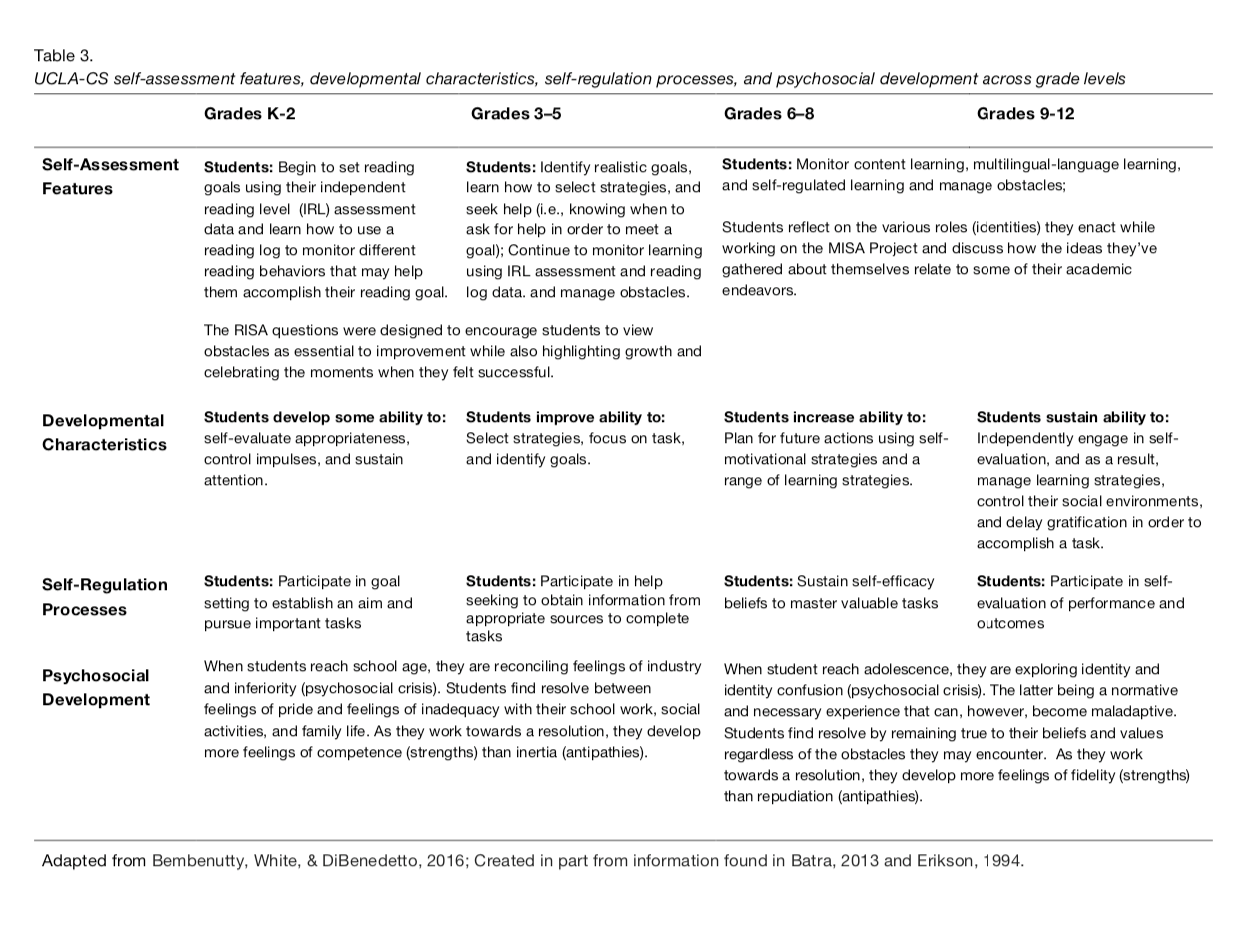
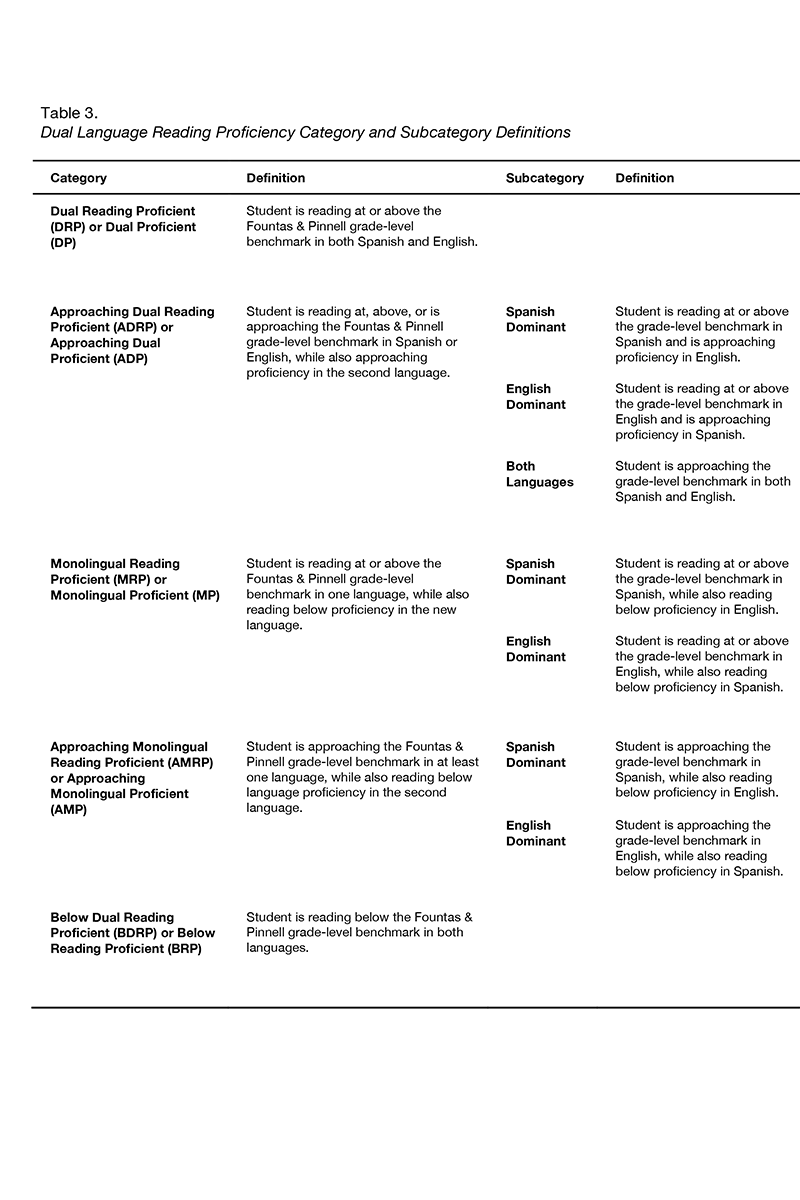
“No matter what I become I will always try to help…people.” Alex, eighth-grade
“I want to stand up for what I believe in.” Patricia, eighth-grade
“It is very important to communicate in more than one language, to be able to understand other people’s ideas and thoughts.” Kleber, ninth-grade
Teachers Reflected, Revised, and Expanded on Project Elements
A senior teacher (third author) and a researcher (first author) took on the task of refining the self-assessment based on the MISA curriculum and progression, as the MISA Project expanded to the Science Department. In the first semester, some students investigated water quality in World History Class and Chemistry class. The targeted progression dimension was “Active and Critical Participant.” Teachers added questions to the self-assessment that measured students’ perception of themselves as active and critical participants. This was important because teachers wanted to see if the curriculum was supporting students to see themselves this way. Refer to the following excerpt for one example of a tenth grade student’s response to questions about taking action. The Social Studies and Science Divisions are administering the MISA self-assessment this Spring 2019 and are planning to continue this practice next year.
MISA Self-Assessment Excerpt
Taking Action
Below is an excerpt highlighting a tenth grader’s response to self-assessment questions about taking action.
Ivan
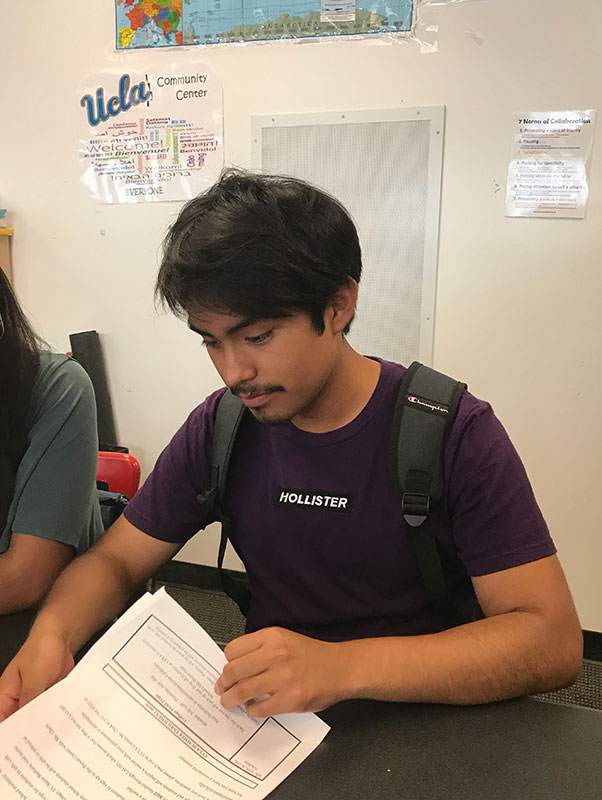 What social issue did you investigate this semester in Science, Social Studies, and Art?
I studied the social issues surrounding water.
In what ways did investigating this issue in your community help you become more active and engaged?
I have gathered more information about our city’s water. With this information I can tell others that our tap water is indeed safe because we have evidence to back it up with. Some people will still not believe us, just like many of my classmates, but those who do know now that our tap water is safe to drink. I am not really aware about my community’s relationship with tap water, but it would be good to inform them that it is indeed safe to drink.
Complete the following sentence starter: The work I did investigating a social issue is important because…
I am now knowledgeable about our water situation within our city primarily. I was able to learn about whether or not our tap water was safe to drink. I can now inform my family and community about our tap water and the truth about it. Perhaps they can trust it and would consider it a new drinking source for their family.
Describe something you did while investigating a social issue that made you feel like you made a difference in your community.
The best thing is conducting our tests in chemistry. No family in my community would have the resources necessary to carry out our procedures. It would be hard for a family in my community to test the tap water in their home therefore making them question it. By conducting the test I now possess the information to spread the truth within our community.
Describe how the work you did investigating a social issue = hope and change.
In order to create change we must first be aware about the situation that we find ourselves in. In investigating the issue my classmates and I have become knowledgeable about the water in our neighborhoods. We can spread this information and inform our community about it. This would leave us to decide whether or not change is required and if our hopes have been met or not.
Students Completed Projects Using Multiple Languages
Although the MISA Self-Assessment is in the early stages of development, the teacher-researcher partnership explored students’ constructed responses (written, open-ended). Upon analyzing the data from the first pilot, they found that 60% (n = 162 students) of the 269 participating students used multiple languages in addition to (or instead of) English while investigating a social issue. Twenty students skipped this item (did not respond) and were omitted from the analysis. In addition, they found that 54% (n = 143 students) of the 267 participating students used multiple languages in addition to (or instead of) English when presenting their final project. Thirty-three students skipped this item (did not respond) and were omitted from the analysis. See MISA findings, Figures 7 & 8, for more information.
Student Reflections Deepened Over Time
Additionally, students’ written reflections deepened over time from Spring 2018 to Fall 2018. For instance, in the Spring of 2018, some students appeared ambivalent about participating in the MISA project and struggled with describing their roles (identities), beliefs, and values (related to their experience with the project). However, after participating in the second MISA pilot the following year, students began demonstrating a stronger sense of self when describing the various roles they enacted during the project, as well as their ideas and goals about who they would like to become and what they would like to do in the near or far future. Refer to Ivan’s 9th and 10th grade self-assessment responses for an example.
MISA Findings:
First Pilot Year, 2017 – 2018
The MISA Self-Assessment was first piloted in the Spring of 2018. About 299 secondary school students (7 – 12 grades) reported the languages they used while investigating a social issue and when presenting their final project.
How many students reported using a language other than English while investigating a social issue?
About half (60%, n = 162) of the 269 secondary school students (7 – 12 grades) reported using a language in addition to (or instead of) English during the project, such as Spanish (n = 149), Korean (n = 10), Tagalog (n = 13), an Indigenous language (n = 3), and Indonesian (n = 2). 30 students did not respond and were excluded from this analysis. See Figure 7.

Figure 7. The languages students reported using while investigating a social issue.
How many students reported using a language other than English while presenting their final project?
About half (54%, n = 143) of the 267 secondary school students (7 – 12 grades) reported using a language in addition to (or instead of) English during the project, such as Spanish (n = 134), Korean (n = 2), Tagalog (n = 4), an Indigenous language (n = 1), and Bisaya (n = 1). 33 students did not respond and were excluded from this analysis. See Figure 8.
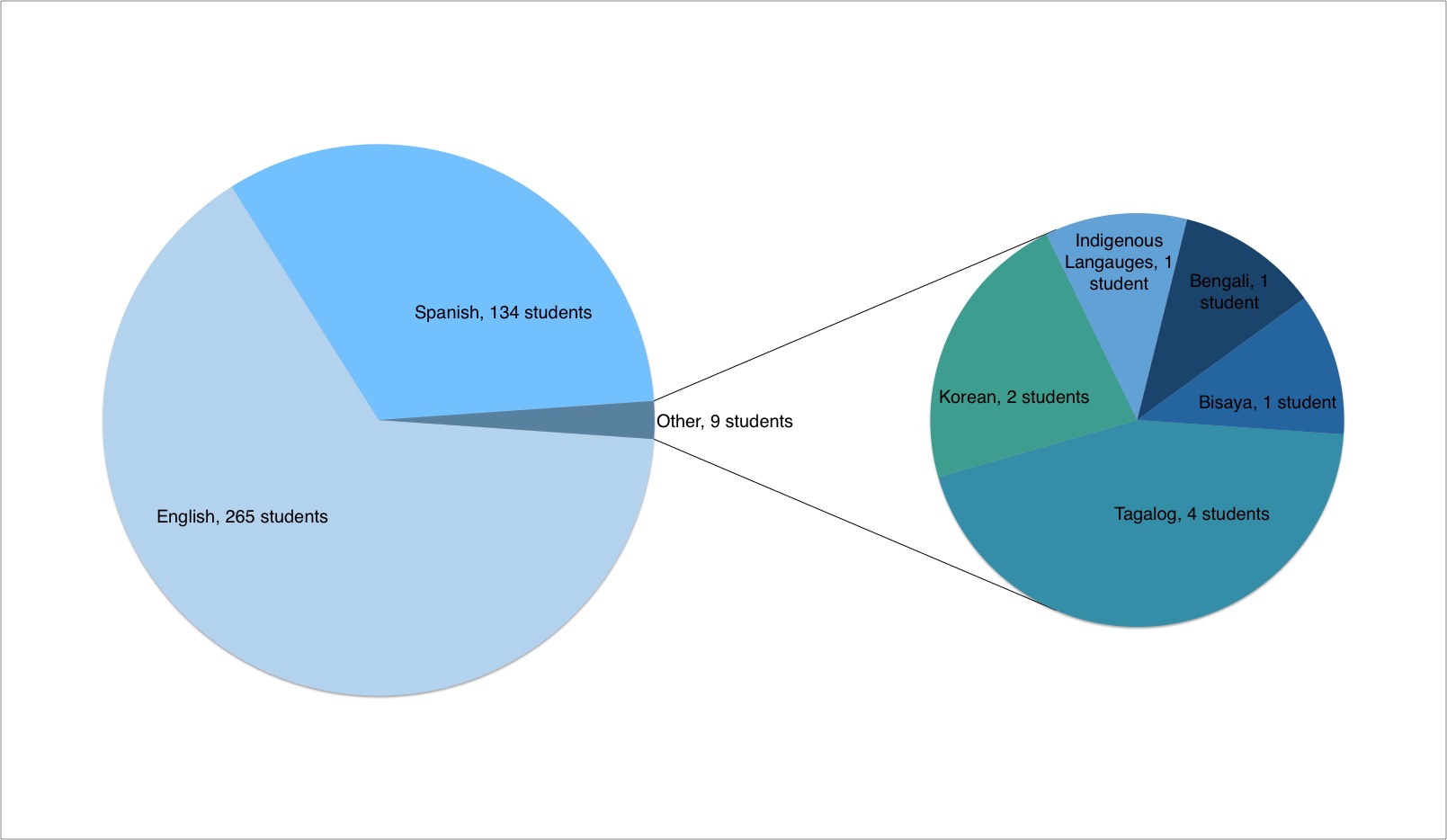
Figure 8. The languages students reported using while presenting a social issue.
Ivan’s 9th and 10th Grade Self-Assessment Responses
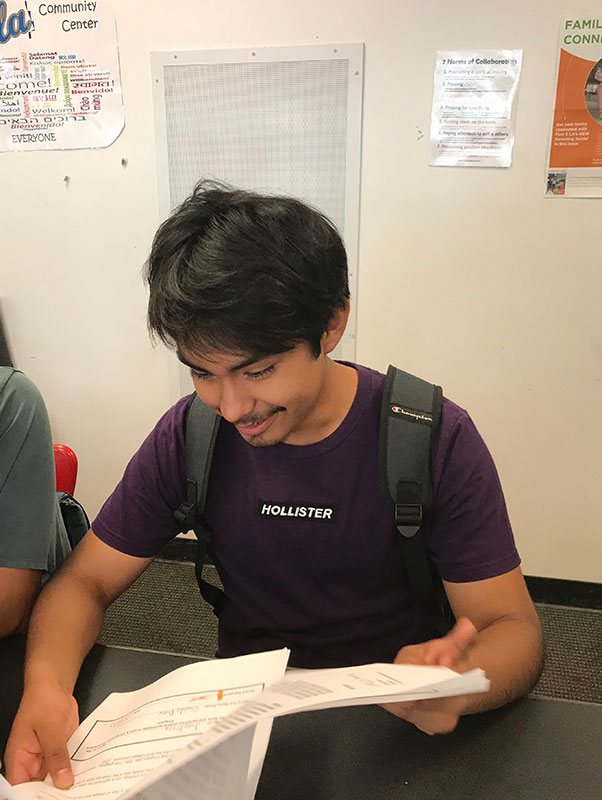
In 9th Grade, Ivan reported studying “houselessness,” and in 10th grade he “studied social issues surrounding water.”
| 9th Grade, Spring 2018 | 10th Grade, Fall 2018 |
| What identity or identities did you enact as you worked on your project? | After investigating a social issue this semester, what roles do you think best describe you? |
| I am a student. | I am a multilingual communicator. I am a researcher. I am a critical thinker. I am a student. |
| Why did you see yourself in this way? | |
| I was forced to work on a project for my grade which is what every student does because we don’t have free will in school. | I was able to communicate and express myself in two different languages through my work and interviews. I am a researcher as well because I conducted tests in chemistry in order to gather more information about the situation instead of stating ignorant claims. Lastly, I am a student too because through having these classes I was able to learn and become aware about the situation that we find ourselves in. |
| In what ways do you think this knowledge about yourself will inform who you would like to become? | |
| I will actually seek better ways to help people without being forced by others. I will voluntarily do what I can to help others. | I would always want to learn about many different things that can not only help me but my community as well. Others don’t have the opportunity to learn like I do therefore it is only right to inform and teach them what others couldn’t. I would also like to become more social with my community. Change starts with an individual and spreads to the community, that is if change is needed. |
| Which languages did you use throughout the development of your project? | |
| English, Spanish | English, Spanish |
| In what ways were you successful at communicating with different community members during the development of your project? | |
| I didn’t talk to anyone during doing my project and I just worked on my own. | I speak Spanish with my elders at home. For the most part I was able to ask them questions and respond successfully. Our conversations were smooth and I didn’t struggle with communicating. |
| What would you do differently next time? Why? | |
| I would try to talk in Spanish to people who prefer to listen in Spanish. I could also print out some of my papers in Spanish | I would probably ask more in depth questions for my family interviews. The questions I asked were pretty basic and didn’t go in depth about their situation. By doing so I would gather more information to make my work better and clear[er]. |
| What did you learn about yourself as a user of two or more languages? Include as many details as you can. | |
| I learned nothing. | I learned that I can communicate with a lot more people than just English speakers. Though I only speak 2 languages, English and Spanish, I can still talk with more people than I would with only a single language. Being a bilingual speaker I have a special skill that can help me socialize with others [and have] more profound conversations. This skill that I posses can surely help me and others. |
“I am a multilingual communicator. I am a researcher. I am a critical thinker. I am a student.” Ivan, tenth-grade
Conclusion
Designing, piloting, and establishing a self-assessment system at UCLA-CS informed local language policies. When teachers analyzed students’ responses, they became aware of how students felt being bi- or multilingual users in their respective classrooms and school. Teachers found that many students were privileging English over Spanish. Teachers realized that these insights were in part representative of what students were observing from their teachers, peers, and other support staff because they too were privileging English. This realization prompted teachers to incorporate more Spanish outside the classroom when conversing with students and their colleagues, as well as during grade-level meetings. Teachers became more cognizant of how much Spanish and English they were modeling each day. In effect, the design cycle and pilot helped teachers become more aware of language ideologies and their connection to language development and literacy. Data collected and analyzed during the design cycles and pilot helped teachers make informed decisions about how to modify instruction and scaffold students with making connections between content, bi/multilingual and biliteracy development, and social justice in the classroom and beyond.
Additionally, the teacher-researcher partnership found that self-assessment instruments and routines afforded students opportunities to link content instruction to their bilingual skills, as well as reflect on how communication is interconnected to identity, community, and social justice . For instance, the RISA empowered students to take ownership of their bi/multilingual reading development. As students reflected and set measurable goals, they learned to build on their assets. The RISA facilitated productive conversations with students and their parents about their Spanish and English reading development, strengthening support for a child’s biliteracy development at home. Through the RISA routines, students practiced critical thinking skills and vocabulary, which provided a strong foundation for self-regulated learning. Moreover, the MISA Self-Assessment is laying the groundwork for how the entire school can reshape curriculum and instruction to reflect the mission and vision of the school that is grounded in social justice, bi/multilingualism, biliteracy, collaboration, and academic rigor. The MISA projects, progression, and self-assessment promise to show the school the way forward in how they think about professional development, allocate resources, engage with the school community, and provide support to new and veteran teachers to create curriculum collaboratively. As the dual language program grows to the secondary grades, student reflection will continue to play a critical role indicating to what extent instruction radiates bi/multilingualism, biliteracy, multiculturalism, anti-racism, and social action.
In sum, self-assessment provides unique insight into the role of language, culture, and identity in a child’s education. This insight is invaluable for a dual language school because it can inform improvement efforts with bi/multilingual curriculum, instruction, and assessment across the primary and secondary grades. Policies that guide multilingual and multicultural educational programs ought to promote the importance of self-assessment as part of a school’s local summative and formative assessment system.
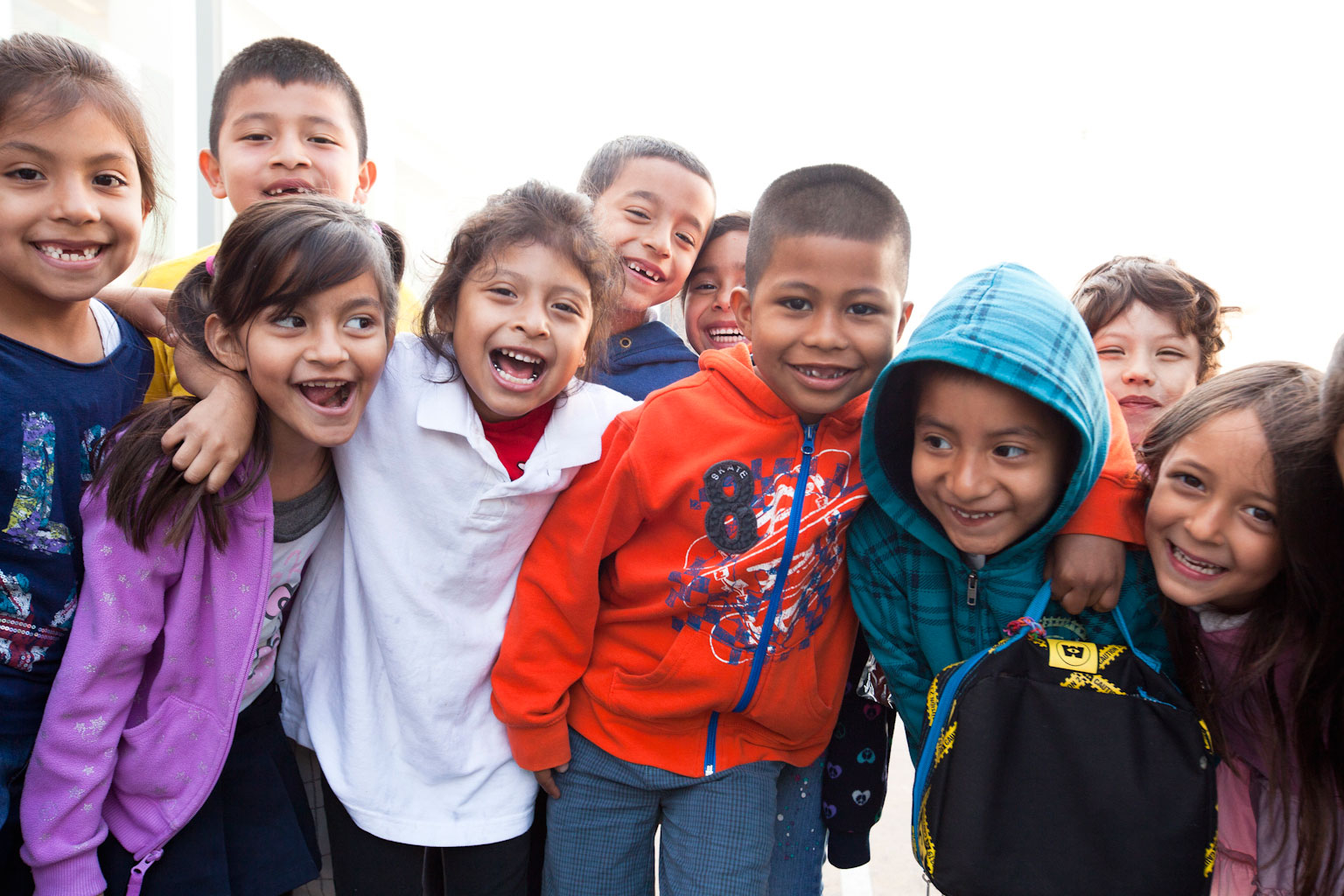
References
Ainsworth, L. (2007). Common formative assessment: The centerpiece of an integrated standards-based assessment system. In D. B. Reeves (Ed.), Ahead of the curve: The power of assessment to transform teaching and learning, (pp. 79-102). Bloomington, IN: Solution Tree.
Andrade, H. L., & Heritage,M. (2018). Using formative assessment to enhance learning, achievement, and academic self-regulation. New York, NY: Routledge.
Bailey, A. L. & Heritage, M. (2018). Self-regulation in learning: The role of language and formative assessment. Cambridge, MA: Harvard Education Press.
Batra, S. (2013). The psychosocial development of children: Implications for education and society — Erik Erikson in context. Contemporary Education Dialogue, 10(2), 249-278.
Bembenutty, H., White, M. C., & DiBenedetto, M. K. (2016). Applying social cognitive theory in the development of self-regulated competencies throughout K-12 grades. In Psychosocial skills and school systems in the 21st century, (pp. 215-239). Springer, Cham.
Bohlmann, N. L., Maier, M. F., & Palacios, N. (2015). Bidirectionality in self-regulation and expressive vocabulary: Comparisons between monolingual and dual language learners in preschool. Child Development, 86(4), 1094-1111.
Brown, G. T. L., & Harris, L. R. (2013). Student self-assessment. In J. H. McMillan (Ed.). The SAGE handbook of research on classroom assessment (pp. 367-393). Thousand Oaks, CA: Sage.
Cerda, J., Bailey, A. L., & Heritage, M. (2018). “Social justice is access and discussion”: Contexts for self- and co-regulatory learning in a dual language elementary school classroom. Manuscript in preparation.
Dörnyei, Z., & Ryan, S. (2015). The psychology of the language learner revisited. New York, NY: Routledge.
Duckworth, A. L., Tsukayama, E., & May, H. (2010). Establishing causality using longitudinal hierarchical linear modeling: An illustration predicting achievement from self-control. Social Psychology and Personality Science, 1(4), 311–317.
Erikson, E. H. (1994). Identity and the life cycle. New York, NY: W. W. Norton & Company.
Fuligni, A. J., Witkow, M., & Garcia, C. (2005). Ethnic identity and the academic adjustment of adolescents from Mexican, Chinese, and European backgrounds. Developmental psychology, 41(5), 799.
Gay, G. (2010). Culturally responsive teaching: Theory, research, and practice. Teachers College Press.
Gee, J. P. (2015). Social linguistics and literacies: Ideology in discourse. New York, NY: Routledge.
Harris, L. R., & Brown, G. T. (2018). Using self-assessment to improve student learning. New York, NY: Routledge.
Higgins, E. T. (1987). Self-discrepancy: a theory relating self and affect. Psychological review, 94(3), 319.
Hadwin, A. F., Järavelä, S., & Miller, M. (2018). Self-regulation, co-regulation, and shared regulation in collaborative learning environments. In D. H. Schunk & J. A. Greene (Eds.), Handbook of self-regulation of learning and performance (2nd ed., pp. 83-106). New York, NY: Routledge.
Howard, E. R., Lindholm-Leary, K. J., Rogers, D., Olague, N., Medina, J., Kennedy, B., Sugarman, J., & Christian, D. (2018). Guiding Principles for Dual Language Education (3rd ed.). Washington, DC: Center for Applied Linguistics.
Ladson‐Billings, G. (1995). But that’s just good teaching! The case for culturally relevant pedagogy. Theory into practice, 34(3), 159-165.
Los Angeles School District. (2018). Master plan for English learners and standard English learners.
Marsh, H. W., & Martin, A. J. (2011). Academic self‐concept and academic achievement: Relations and causal ordering. British Journal of Educational Psychology, 81(1), 59-77.
May, S. (Ed.). (1999). Critical multiculturalism: Rethinking multicultural and antiracist education. Psychology Press
McCaslin, M., & Hickey, D. T. (2001). Self-regulated learning and academic achievement: A Vygotskian view. In B. Zimmerman & D. Schunk (Eds.), Self-regulated learning and academic achievement: Theory, research, and practice (2nd ed., pp. 227–252). Mahwah, NJ: Erlbaum.
McClelland, M. M., Acock, A. C., Piccinin, A., Rhea, S. A., & Stallings, M. C. (2013). Relations between preschool attention span-persistence and age 25 educational outcomes. Early Childhood Research Quarterly, 28, 314–324.
Mottier Lopez, L., & Allal, L. (2007). Sociomathematical norms and the regulation of problem solving in classroom microcultures. International Journal of Educational Research, 46, 252-265.
Nieto, S. (2009). Multicultural education in the United States: Historical realities, ongoing challenges, and transformative possibilities. In J. A. Banks (Ed.), The Routledge international companion to multicultural education (pp. 99-115). Routledge.
Oyserman, D., & Destin, M. (2010). Identity-based motivation: Implications for intervention. The Counseling Psychologist, 38(7), 1001-1043.
Panadero, E., Brown, G. T., & Strijbos, J. W. (2016). The future of student self-assessment: A review of known unknowns and potential directions. Educational Psychology Review, 28(4), 803-830.
Paris, D. (2012). Culturally sustaining pedagogy: A needed change in stance, terminology, and practice. Educational researcher, 41(3), 93-97.
Quartz, K. H., Kawasaki, J., Sotelo, D., & Merino, K. (2014). Supporting assessment autonomy: How one small school articulated the infrastructure needed to own and use student data. Journal of Educational Change, 15(2), 125-152.
Ramdass, D., & Zimmerman, B. J. (2008). Effects of self-correction strategy training on middle school students’ self-efficacy, self-evaluation, and mathematics division learning. Journal of Advanced Academics, 20(1), 18-41.
Sergiovanni, T. J. (2001). Leadership: What’s in it for schools? New York, NY: Routledge/Falmer.
Winne, P. H., & Hadwin, A. F. (2008). The weave of motivation and self-regulated learning. In D. H. Schunk & B. J. Zimmerman (Eds.), Motivation and self-regulated learning: Theory, research, and application (pp. 297-314). Mahwah, NJ: Erlbaum.
Yin, R. Y. (2003). Applications of case study research (2nd ed.). Thousand Oaks, CA: Sage.
Zimmerman, B. J. (1990). Self-regulated learning and academic achievement: An overview. Educational psychologist, 25(1), 3-17.
About the Authors
Janet Cerda
Janet Cerda is a doctoral candidate in Human Development and Psychology at UCLA. She taught in New York City as a dual-language immersion teacher (grades 3 – 6). She is a graduate student researcher at the UCLA Center for Community Schooling and at the National Center for Research on Evaluation, Standards, and Student Testing (CRESST) at UCLA. Her research focuses on investigating the biliteracy development of immigrant children and youth over time and examining assessment practices that document K-12 multilingual and multicultural teaching and learning.
Nancy García
Nancy García is a bilingual fourth/fifth grade teacher at UCLA Community School, Los Angeles. She has been teaching for 23 years. Her area of expertise is in reading instruction and English Language Development. She holds a National Board Certificate in the area of English as a New Language. She mentors student teachers and new teachers, and trains teachers in LAUSD through salary point credit classes. She also presents at educational conferences such as the California Association for Bilingual Education and at UCLA. She has held many leadership roles such as UTLA chapter chair, lead teacher at her school site, and holds an administrative credential.
Rosa Jiménez
Rosa Jiménez is a high school history teacher at the UCLA Community School in the Koreatown neighborhood of Los Angeles. She has been teaching for 12 years and has been a lifelong community organizer as well. She is mentor teacher for student teachers and mentor for new teachers learning to balance life, community organizing, and teaching. She is member of Students Deserve, a coalition of parents, students and teachers in Los Angeles that has the mission to transform public education in Los Angeles. Students Deserve recently played a critical role in the Los Angeles Teacher strike of 2019.
Queena Kim
Queena Kim is an Assistant Principal at the UCLA Community School, a public TK-12 Grade span school in Los Angeles. She was a founding Lead Teacher of the school before becoming an administrator at the school. Prior to that she taught for 9 years as an elementary Spanish and English bilingual teacher. She supports the development of bilingual program and guides the professional development of the staff.